

Visiting a Litter
Choosing a Cavalier King Charles Spaniel puppy is a significant decision. A puppy may be joining your family for many years, so taking the time to visit the litter, meet the breeder and observe the puppies in the environment where they have been raised is one of the most important steps you can take.
A photograph, video or online advertisement can tell you what a puppy looks like. A visit can tell you much more.
When you visit a litter, you are not simply choosing the puppy you find cutest. You are assessing the breeder, the mother, the puppies, their environment, their early experiences and the breeder's approach to health, welfare and responsible breeding.
For Queensland puppy buyers, there is also important information to verify before committing to a puppy, including the breeder's Supply Number and the puppy's identification and documentation. Queensland Government specifically encourages prospective owners to check the Supply Number and visit the breeder's premises where possible.
A responsible breeder should be comfortable with you asking questions, observing the litter and seeing where the puppies were born and raised. You should be just as interested in choosing the breeder as you are in choosing the puppy.
Visiting a Cavalier King Charles Spaniel Litter:
What to Look For
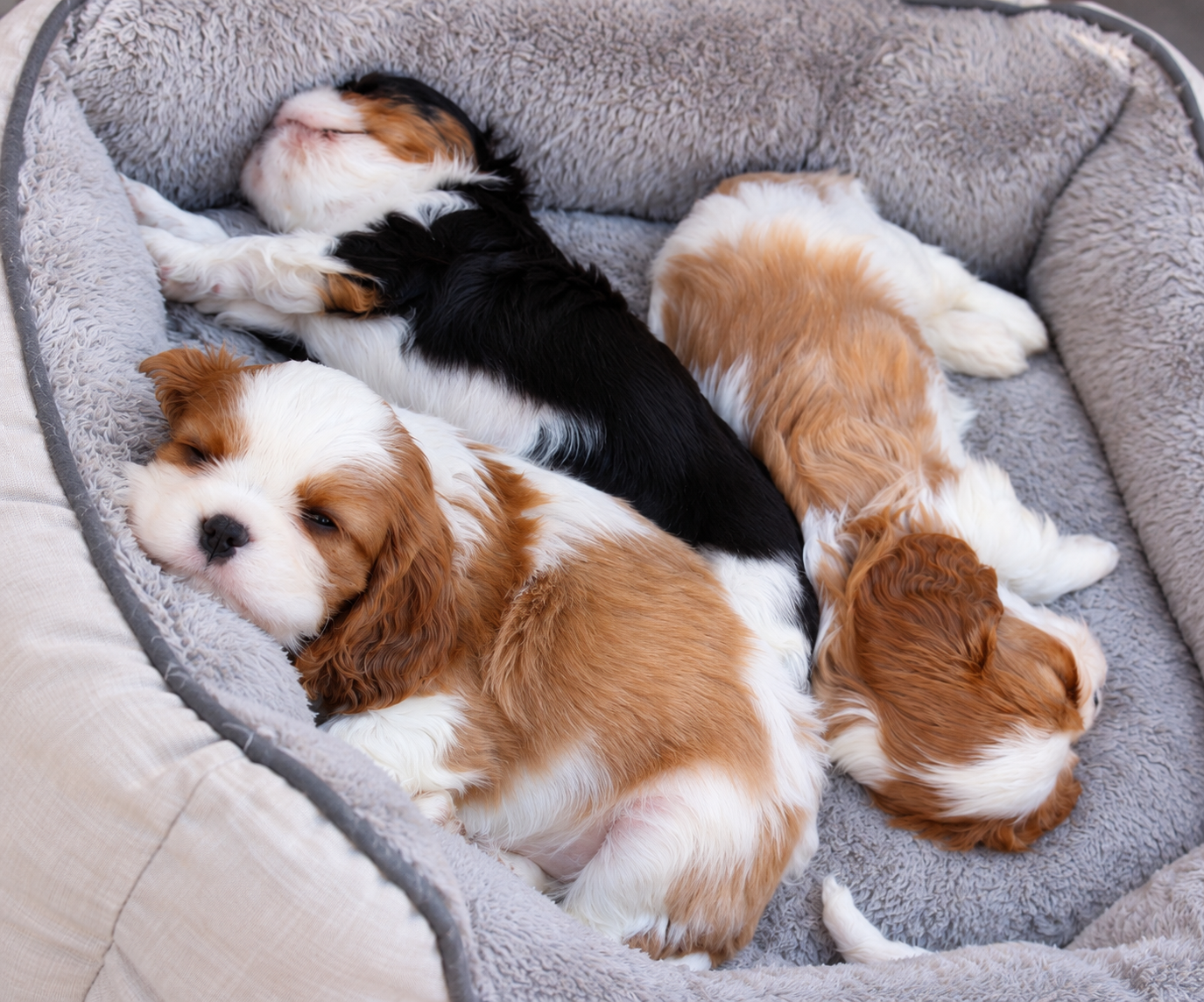
Photo credit: Cavalier King Charles Spaniel Club (Queensland)
Why Visiting the Litter Matters
Responsible puppy selection should never be based solely on photographs, colour, sex, price or the puppy that immediately runs towards you.
A visit allows you to observe things that cannot easily be assessed online, including:
Where the puppies are actually being raised
The cleanliness and safety of their environment
The condition of the mother
The puppies' general health and behaviour
How the breeder interacts with the dogs
How the puppies respond to people
Whether the puppies have appropriate opportunities for play and exploration
Whether the breeder is knowledgeable and transparent
Whether the breeder asks questions about your suitability as an owner
Whether the breeder is willing to provide health and veterinary documentation
The RSPCA recommends visiting the place where a puppy was born and raised and meeting the mother, and the father where possible, as part of assessing a responsible breeder.
Before You Visit a Cavalier Litter
A good litter visit begins before you arrive.
Ideally, you should already have researched:
The Cavalier King Charles Spaniel breed
The breed's health considerations
The breeder
The breeder's history and reputation
The parents of the litter
Recommended health testing
The breeder's registration or accreditation
The puppy's expected age when going home
The proposed puppy contract
What documentation will be provided
The breeder's Supply Number
Don't be afraid to ask questions before arranging a visit.
A responsible breeder should generally welcome informed prospective owners rather than treating questions as an inconvenience.
Ask to Visit Where the Puppies Are Raised
This is one of the most important principles when choosing a puppy. See the environment where the puppies actually live.
Queensland Government advises prospective puppy buyers to work with responsible breeders who allow visits to their premises. If an in-person visit genuinely cannot occur, the Queensland Government recommends that the breeder arrange a video call.
Be cautious if:
You are told you cannot visit
You are only offered photographs
The breeder insists on meeting somewhere else
The puppy is delivered to you without you seeing where it was raised
You are shown only one room or a staged area
You are discouraged from seeing the mother
The breeder provides excuses for why you cannot see the breeding dogs
RSPCA guidance similarly warns against buying an animal sight unseen and recommends meeting the puppy and its parents in person before proceeding.
Remember
A beautifully presented room does not necessarily tell you where the puppies normally live. Look for evidence that the environment you are shown is genuinely where the litter is raised.
What Should the Puppy Environment Look Like?
There is no single "perfect" setup for raising puppies. A responsible breeder may raise puppies in a home, purpose-designed area or another appropriate environment. What matters is whether the environment provides for the puppies' health, safety, development and welfare.
Look for an environment that is:
Clean
Safe
Comfortable
Appropriately ventilated
Free from obvious hazards
Large enough for the puppies to move around
Suitable for sleeping and resting
Appropriate for play and exploration
Supplied with clean water when appropriate
Equipped with suitable bedding
Enriched with age-appropriate toys and experiences
You should also consider whether the puppies appear accustomed to normal household activity and whether the breeder is deliberately exposing them to appropriate experiences.
The RSPCA recommends assessing the living conditions, including cleanliness, space, bedding, food, toys and other indicators that the puppies are genuinely being raised in the environment you are shown.
Meet the Mother
Meeting the mother is essential.
The mother can provide valuable information about:
Her physical condition
Her temperament
Her behaviour around people
Her relationship with the puppies
The breeder's treatment of breeding dogs
A responsible breeder should be willing to show you the mother and discuss her health, temperament, breeding history and relevant health testing.
The RSPCA specifically recommends meeting the mother and, where possible, the father, and assessing their health, temperament and welfare.
What Should the Mother Look Like?
The mother should appear to be in reasonable physical condition for her stage of pregnancy or recovery from giving birth.
Look for a dog who appears:
Alert
Comfortable
Appropriately nourished
Clean
Mobile
Interested in her surroundings
Comfortable interacting with the breeder and puppies
Remember that a mother who has recently given birth may naturally look tired or have changes associated with nursing. You are not expecting a perfectly groomed show dog. You are looking for evidence of appropriate care and welfare.
Be concerned if the mother appears:
Extremely thin
Weak or lethargic
Dirty or neglected
Injured
Persistently frightened
Unwell
Extremely distressed around the breeder
Reluctant or unable to move normally
If you are concerned about what you see, ask questions.
Can You Meet the Father?
Ideally, you should be able to see the father too. However, this is not always possible. A responsible breeder may use a stud dog owned by somebody else or located interstate or elsewhere.
If the father does not live with the breeder, ask:
Where does he live?
Who owns him?
Can you see photographs or video?
Can you see his pedigree?
What health testing has been undertaken?
What is known about his temperament?
Why was he selected for this mating?
Dogs Australia recommends appropriate breed-specific health testing when selecting a Cavalier puppy, and prospective buyers should ask breeders for evidence of relevant testing rather than relying on general statements about the parents being "healthy".
Look at the Whole Litter
Try not to focus exclusively on the puppy you have been shown. Observe the litter as a group.
Look at whether the puppies appear:
Alert
Interested in their surroundings
Appropriately active for their age
Comfortable interacting with people
Comfortable interacting with their littermates
Clean
Well cared for
Free from obvious injury or illness
Puppies naturally sleep for substantial periods, so a litter that happens to be sleeping when you arrive is not necessarily concerning.
The breeder should be able to explain their normal routine and allow you to observe the puppies at an appropriate time.
Observe Puppy Behaviour
Puppies do not all have identical personalities.
Some may be:
Bold
Curious
Cautious
Energetic
Relaxed
More independent
More people-oriented
There is no requirement for every puppy to behave identically during a single visit.
Instead, look at the overall pattern of behaviour.
Do the puppies appear appropriately curious and engaged?
Do they interact with one another?
Do they recover from ordinary noises or changes in their environment?
Do they show an appropriate interest in people?
Are they extremely fearful or withdrawn?
The RSPCA recommends watching how puppies and adult dogs behave around people and other dogs and considering whether they appear friendly, calm and appropriately socialised.
Don't Expect Every Puppy to Run Straight to You
This is important. A puppy that immediately climbs into your lap is not automatically healthier, better socialised or a better match than a puppy that initially observes you from a short distance.
Puppies have individual personalities. A responsible breeder should also be observing those differences and may be able to tell you which puppy is likely to suit your lifestyle. For example, the ideal puppy for an active household may not necessarily be the same puppy best suited to a quieter home. Let the breeder help match the puppy to the family.
Examine the Puppies' General Health
You are not expected to perform a veterinary examination. However, you can observe obvious signs of health and welfare.
Look for puppies that appear:
Bright and alert when awake
Comfortable moving around
Free from obvious injuries
Clean
Appropriately nourished
Free from obvious discharge around the eyes or nose
Free from obvious skin problems
Free from excessive coughing or sneezing
Free from obvious diarrhoea or soiling
The RSPCA's puppy buyer guidance recommends checking that puppies and adult dogs appear healthy, move freely and easily, have clear eyes, noses and ears, have healthy coats and are free from obvious injury or parasites.
Remember
Appearance is not a veterinary health certificate. A puppy can look perfectly healthy while carrying a genetic condition or developing a health problem later in life. This is why responsible breeding, appropriate health testing and veterinary care are so important.
Look at the Puppies' Eyes, Ears and Coats
When observing the litter, look for obvious abnormalities.
Eyes
Eyes should generally appear clear and free from obvious discharge.
Nose
Be alert to persistent discharge, difficulty breathing or repeated sneezing.
Ears
Look for obvious discharge, redness or unpleasant odour.
Coat and skin
The coat should appear appropriately clean and healthy for the puppy's age.
Look for obvious:
Hair loss
Skin irritation
Parasites
Sores
Excessive scratching
Movement
Watch puppies walking and playing. They should be able to move normally for their age without obvious lameness or difficulty.
If something concerns you, ask the breeder and, where appropriate, seek independent veterinary advice.
Ask About Cavalier-Specific Health Testing
This is particularly important when buying a Cavalier King Charles Spaniel. Cavaliers are predisposed to a number of inherited and breed-associated health conditions, so responsible breeders should take health seriously and use appropriate screening and breeding strategies.
Dogs Australia identifies breed-specific health testing as an important consideration when choosing a Cavalier puppy. Its guidance discusses cardiac testing, eye examination, DNA testing for Episodic Falling Syndrome and Curly Coat/Dry Eye Syndrome, and MRI screening for Syringomyelia where available.
Ask the breeder: Which health tests have been undertaken on the parents?
Then ask: Can I see the actual certificates or results?
This distinction matters.
"Both parents are health tested" is not the same as providing evidence of what was tested, when it was tested and what the results were.
Health Testing Does Not Mean "Health Guaranteed"
This is one of the most important things for prospective Cavalier owners to understand. Health testing can help identify risks and inform breeding decisions. It cannot guarantee that a puppy will never develop a health condition. Genetic conditions can be complex, tests have limitations, and not every disease has a definitive test.
A responsible breeder should be comfortable discussing:
What tests were performed
Why those tests were selected
The results
What the results mean
How the results influenced the breeding decision
Known health conditions in the wider family
What they are doing to reduce risk
A breeder who says "our puppies are 100% healthy because the parents were tested" should be approached cautiously.
Ask About the Puppy's Veterinary Care
Ask what veterinary care the puppies have received.
Depending on their age, this may include:
Veterinary examinations
Vaccinations
Microchipping
Worming
Parasite control
Other treatment where required
Ask to see the relevant records. A responsible breeder should be able to explain what has been done and provide appropriate documentation when the puppy goes home.
Queensland Government advises puppy buyers to obtain vaccination records, registration certificates, microchip details and other relevant information when acquiring a puppy.
Ask About Socialisation
Socialisation is far more than allowing puppies to play together. Ask the breeder what experiences the puppies have had.
Depending on age and individual circumstances, this may include gradual exposure to:
Different people
Household sounds
Different surfaces
Grooming and handling
Car travel
Everyday household activities
Appropriate toys
Safe outdoor experiences
Veterinary handling
Novel objects and environments
Ask: "What have you done to socialise the puppies?"
A good breeder should be able to provide specific examples rather than simply saying: "They're very well socialised."
Ask About Early Learning
Early puppy development is an important responsibility.
Ask whether the breeder has begun introducing:
Gentle handling
Grooming
Nail handling
Basic recall
Appropriate toilet routines
Crate or pen experiences
Calm settling
Different sounds
Different surfaces
Short periods away from littermates
Appropriate enrichment
You are looking for evidence that the puppies have been given opportunities to develop confidence and life skills appropriate to their age.
Ask What the Puppies Are Eating
Find out:
What food the puppies are eating
How many meals they receive
What portion sizes are appropriate
Whether they are fully weaned
When their diet will change
What food will be sent home with them
What treats they have been introduced to
A responsible breeder should be able to provide clear feeding instructions.
Avoid making a sudden food change when your puppy arrives home. Gradual dietary transitions are generally easier on a puppy's digestive system.
Ask About the Puppy Going Home
In Australia, puppies should not be separated from their mother before eight weeks of age. RSPCA puppy buyer guidance states that puppies should be at least eight weeks old and fully weaned before adoption or purchase.
Ask: "At what age will the puppies go to their new homes?"
The breeder should be able to explain why that age is appropriate for the individual litter.
A puppy being available unusually early should be treated as a significant warning sign.
Ask About the Breeder's Puppy Selection Process
Do not assume that you are expected to choose a puppy entirely on your own. A thoughtful breeder will have spent considerable time observing the litter.
Ask:
"How will you match each puppy with its new family?"
A responsible breeder may consider:
Temperament
Energy level
Confidence
Sociability
Activity level
Family circumstances
Experience with dogs
Other pets
Lifestyle
Whether the puppy is intended as a companion, show prospect or breeding prospect
The objective should be a good long-term match, rather than simply selling whichever puppy the buyer prefers.
Expect the Breeder to Ask You Questions
This is a very positive sign. A responsible breeder should care where their puppies are going.
Don't be surprised if the breeder asks about:
Your home
Your lifestyle
Your working hours
Your experience with dogs
Other pets
Children
Your expectations of the breed
Exercise
Grooming
Training
Veterinary care
Whether you intend to show or breed
What you will do when you go on holidays
Your plans for the dog's entire lifetime
The RSPCA considers a breeder's genuine interest in whether a prospective owner is a suitable match to be an important characteristic of responsible breeding. A breeder who interviews you is not necessarily being difficult. They may be demonstrating that they care about their puppies.
Check the Queensland Supply Number
If you are purchasing a puppy in Queensland, make checking the breeder's Supply Number part of your due diligence.
Queensland's Dog Breeder Register states that a person who has a female dog with a litter born on or after 26 May 2017 must have a Supply Number within 28 days of the litter's birth, subject to the relevant legal provisions. Dogs and puppies generally must not be sold, supplied or advertised without a Supply Number identifying the breeder or providing an applicable exemption.
Don't simply accept the number.
Check it.
The Queensland Dog Breeder Register allows prospective owners to look up a Supply Number and verify that it is valid and identifies the breeder.
Check a Queensland breeder's Supply Number
Registered Does Not Automatically Mean Responsible
You may encounter terms such as:
Registered breeder
Dogs Queensland breeder
Pedigree breeder
Government-registered breeder
Member of a breed club
These can be useful pieces of information, but registration alone should not be your entire assessment of a breeder.
Look at the breeder's actual practices.
Ask:
Do they health test?
Do they prioritise welfare?
Do they raise puppies appropriately?
Do they allow you to see where puppies live?
Do they provide documentation?
Do they know the breed?
Do they select breeding dogs responsibly?
Do they provide support after purchase?
Do they take responsibility for their puppies throughout their lives?
RSPCA guidance recommends assessing the breeder's actual standards of care and responsible breeding practices rather than relying solely on labels.
Red Flags When Visiting a Litter
Some warning signs should make you pause before proceeding.
🚩 You cannot see where the puppies live
This is one of the most significant concerns.
🚩 You cannot meet the mother
There may be legitimate circumstances where this is impossible, but you should receive a credible explanation.
🚩 The breeder wants to meet you somewhere else
This can prevent you from assessing the breeding environment.
🚩 The puppies appear unwell
Persistent coughing, diarrhoea, discharge, obvious skin problems, lethargy or difficulty moving should not be ignored.
🚩 The mother appears neglected
A mother who is severely underweight, unwell, injured or extremely distressed warrants concern.
🚩 The breeder refuses to show health records
Be cautious of verbal claims without supporting documentation.
🚩 The breeder cannot explain their health-testing program
A responsible Cavalier breeder should understand the health issues relevant to the breed.
🚩 There are always multiple litters or breeds available
This may warrant further investigation. RSPCA notes that frequent advertisements and multiple breeds from the same seller can be an indication of large-scale breeding.
🚩 You are pressured to pay immediately
Pressure, urgency and emotional manipulation are classic warning signs.
🚩 The puppy can be delivered without you visiting
Be particularly cautious about buying a puppy sight unseen.
🚩 The breeder doesn't ask you any questions
A breeder who appears interested only in taking your money rather than finding an appropriate home should raise concerns.
Take Notes During Your Visit
It can be surprisingly difficult to remember everything afterwards.
Consider taking notes about:
Breeder
Date of visit
Mother
Father
Health testing
Veterinary care
Vaccinations
Microchipping
Worming
Food
Socialisation
Puppy environment
Temperaments
Contract
Registration
Supply Number
Questions you still need answered
If the breeder permits photography or video, ask first.
Questions to Ask a Cavalier Breeder
Take this list with you.
About the litter
Was this litter planned?
Why did you choose this particular mating?
How old is the mother?
How many litters has she had?
How old was she when she first had puppies?
What is the history of the mother?
Who is the father?
Where does he live?
Can I see his health records?
About health
What health testing has been performed?
Can I see the original certificates/results?
What cardiac testing has been performed?
What eye testing has been performed?
What DNA testing has been performed?
Has MRI screening been undertaken where appropriate?
Are there known health problems in the parents or close relatives?
What veterinary clinic cares for the dogs?
About the puppies
Have the puppies been veterinary checked?
Have they been vaccinated?
Have they been microchipped?
What parasite treatments have they received?
What are they eating?
How often are they fed?
What socialisation have they received?
What experiences have they had outside the litter?
About going home
At what age will the puppy leave?
What documentation will I receive?
Is there a written puppy contract?
What happens if I can no longer keep the dog?
Will you take the puppy back or help with rehoming?
What ongoing support do you provide?
About Queensland requirements
What is your Supply Number?
Can I verify it on the Queensland Dog Breeder Register?
What If You Cannot Visit in Person?
There may be legitimate circumstances where an in-person visit is not possible. For example, the breeder may be interstate, travel may be impractical or other circumstances may prevent a visit. Queensland Government recommends that where an in-person visit cannot occur, a breeder should arrange a video call.
A video call should ideally allow you to:
See the puppies live
See their mother
See the environment
Ask questions in real time
See the puppies interacting
See the breeder handling the dogs
However, a video call is not necessarily equivalent to an in-person visit. If you cannot visit, increase your due diligence rather than reducing it.
What About Buying a Puppy Online?
Online advertising can be useful for finding breeders, but it should be the beginning of your research, not the end.
Be cautious of:
Stock photographs
Stolen breeder photographs
Newly created websites
Social media accounts with little history
Sellers who communicate only by text or email
Puppies supposedly available immediately
Unusually low prices
Multiple breeds advertised
Requests for payment before meeting
Delivery-only arrangements
RSPCA warns against buying animals sight unseen and highlights the importance of meeting the animal, parents and breeder in person.
Read: Puppy Scams
The Visit Is Also About Choosing the Breeder
Perhaps the most important mindset shift is this: You are interviewing the breeder too.
Ask yourself:
Do I trust this person?
Do they genuinely care about the breed?
Do they understand Cavalier health?
Are they transparent about health testing?
Do they appear to know their dogs individually?
Are the dogs treated as valued animals rather than breeding stock?
Would I feel comfortable contacting this breeder if my puppy developed a problem?
Would I trust this breeder to help me if I could no longer care for the dog?
If the answer to these questions is yes, you may have found someone worth building a long-term relationship with.
Visiting a Litter: Your Quick Checklist
Before the visit
☐ Research the breeder
☐ Research Cavalier health issues
☐ Ask about health testing
☐ Ask for the Supply Number
☐ Verify the Supply Number
☐ Prepare your questions
☐ Arrange to see where the puppies live
☐ Ask to meet the mother
☐ Ask about the father
During the visit
☐ Observe the environment
☐ Look at the whole litter
☐ Observe the mother
☐ Observe puppy behaviour
☐ Look for obvious signs of illness
☐ Ask about socialisation
☐ Ask about veterinary care
☐ Ask about food
☐ Ask about health testing
☐ Request to see documentation
☐ Ask about the puppy contract
☐ Ask about ongoing breeder support
Before committing
☐ Verify the breeder
☐ Verify the Supply Number
☐ Review health-testing results
☐ Understand the puppy's veterinary history
☐ Understand what documentation you will receive
☐ Read the puppy contract
☐ Understand the breeder's return/rehoming policy
☐ Consider whether the puppy suits your lifestyle
☐ Don't allow pressure to influence your decision
In Conclusion…
Visiting a litter is one of the most important steps in choosing a Cavalier King Charles Spaniel puppy.
Don't simply look at the puppy.
Look at the breeder.
Look at the mother.
Look at the environment.
Look at the whole litter.
Ask questions.
Ask for evidence.
Trust your observations.
A responsible breeder should be proud to show you how their puppies are raised and should be willing to discuss health, temperament, socialisation, veterinary care and the future welfare of every puppy they produce.
And remember: you are not just choosing a puppy. You are choosing the person who brought that puppy into the world and may remain an important source of support for many years to come.
Take your time. If something doesn't feel right, you don't have to buy the puppy. There will always be another litter. There is no need to compromise on the health, welfare or responsible breeding of your future Cavalier.
Important Information
This article is provided for general educational purposes and is not veterinary, legal or professional breeding advice. Individual breeders, litters and puppies must be assessed on their own circumstances.
Queensland's dog breeding and supply requirements can change. Prospective puppy buyers should verify current requirements directly with the Queensland Government before purchasing a puppy.
Queensland Dog Breeder Register
References
Dogs Australia. (n.d.). What to look for when buying a Cavalier King Charles Spaniel puppy. Dogs Australia – Cavalier King Charles Spaniel puppy advice
Queensland Government. (2026). Choosing a responsible dog breeder. Queensland Government – Choosing a responsible dog breeder
Queensland Government. (2026). Getting a dog. Queensland Dog Breeder Register. Queensland Dog Breeder Register – Getting a dog
Queensland Government. (2026). Applying, or renewing a Supply Number. Queensland Dog Breeder Register. Queensland Dog Breeder Register – Supply Numbers
Queensland Government. (2026). Supplying, selling or advertising a dog. Queensland Dog Breeder Register. Queensland Dog Breeder Register – Supplying, selling or advertising a dog
RSPCA Australia. (2024). How do I find a responsible dog or cat breeder? RSPCA Knowledgebase. RSPCA Knowledgebase – Responsible dog breeders
RSPCA Australia. (2026). The Smart Puppy and Dog Buyer's Guide. RSPCA – Smart Puppy and Dog Buyer's Guide
RSPCA Australia. (2022). Is there a safe way to look for a new companion animal online? RSPCA Knowledgebase. RSPCA Knowledgebase – Buying pets online