

THE ULTIMATE GUIDE TO:
Buying a Cavalier King Charles Spaniel Puppy
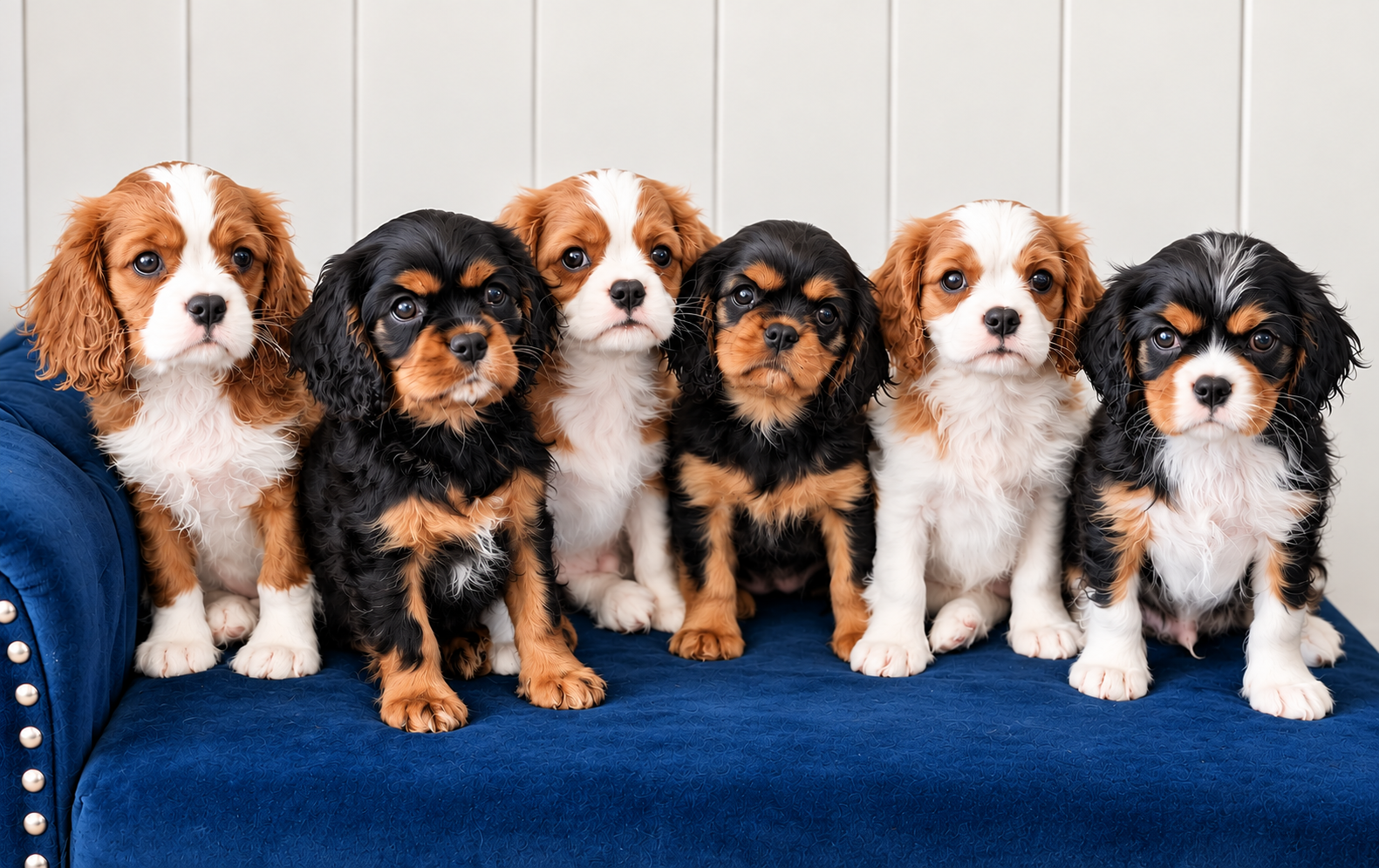
Photo credit: Ray Wilson
The Ultimate Guide to Buying a Puppy
Bringing a Cavalier King Charles Spaniel puppy into your family is an exciting and life-changing decision, but choosing the right puppy involves far more than falling in love with the cutest face. The breeder you choose, the health testing behind the litter, your puppy’s early experiences, temperament, pedigree and the information provided to you can all have a lasting impact on your dog’s health and wellbeing.
The Cavalier King Charles Spaniel Club of Queensland has created The Ultimate Guide to Buying a Puppy to help prospective owners make informed decisions, recognise responsible breeding, ask the right questions and confidently choose a breeder and puppy that are right for them.
A Note to Our Readers
We have created this guide to help prospective puppy buyers make informed, confident decisions when choosing a Cavalier King Charles Spaniel. To make this comprehensive resource easier to read and navigate, we have divided it into three parts:
Part 1 – Preparing to Find Your Puppy
Learn how to prepare before contacting breeders, understand responsible breeding, become familiar with recommended health testing, and create a shortlist of breeders.
Part 2 – Visiting Breeders and Evaluating Puppies
Discover what to look for when visiting a breeder, how to assess the breeding environment and the puppies, understand health certificates, and ask the right questions before making your decision.
Part 3 – Making an Informed Decision
Learn how to interpret registration papers and contracts, recognise positive signs and warning signs, understand breeder support, prepare to bring your puppy home, and complete the ultimate puppy buyer's checklist.
Puppy Buyer's Checklist
Reading through our Ultimate Puppy Buyer’s Guide will help you tick off the below checklist.
If you have any questions, please contact us, we’re here to help.
About the Breeder
☐ Have I researched the breeder?
☐ Have I met the breeder in person?
☐ Have I visited the environment where the puppies are raised?
☐ Have I met the puppy's mother?
☐ Have I asked about the father?
☐ Have I asked why this litter was bred?
☐ Does the breeder take an interest in my lifestyle and circumstances?
About Health
☐ Have I asked about recommended health testing?
☐ Have I seen the relevant health certificates?
☐ Has the breeder explained the results?
☐ Do I understand what the results mean?
☐ Have I asked about health conditions occurring within the bloodline?
☐ Do I understand what veterinary care the puppy has received?
About the Puppy
☐ Does the puppy appear healthy and alert?
☐ Have I observed the puppy interacting naturally?
☐ Have I asked about its temperament?
☐ Has the puppy received appropriate early socialisation?
☐ Do I know what food the puppy is eating?
☐ Do I understand its current routine?
About Registration & Pedigree
☐ Do I understand the puppy's registration status?
☐ Have I seen the registration documentation?
☐ Do I understand the pedigree?
☐ Have I asked the breeder about the puppy's bloodlines?
☐ Do I understand any conditions attached to the registration?
About the Contract
☐ Have I read the sales contract carefully?
☐ Do I understand the health guarantees?
☐ Do I understand the breeder's return policy?
☐ Do I understand any desexing or breeding conditions?
☐ Have I clarified the deposit arrangements?
About the Future
☐ Will the breeder provide ongoing support?
☐ Do I know what to do if I have concerns?
☐ Do I know what happens if my circumstances change?
☐ Am I financially prepared for lifelong dog ownership?
☐ Is everyone in my household ready for a puppy?
PART 1:
Preparing to find your puppy
Before You Start Looking for a Puppy
One of the biggest mistakes prospective owners make is beginning their search by looking at advertisements for puppies. Instead, begin by educating yourself about the breed.
Take time to understand:
Typical exercise requirements.
Grooming needs.
The life expectancy of a Cavalier.
Common health conditions.
Financial commitment.
The role of health testing.
The more knowledge you have before contacting breeders, the easier it will be to recognise breeders who genuinely prioritise the health and welfare of their dogs.
If you are unsure whether a Cavalier King Charles Spaniel suits your lifestyle, we recommend reading Is a Cavalier King Charles Spaniel the Right Dog for You?
Decide Whether a Puppy is Right for You
A puppy is a wonderful addition to many families, but it also brings significant responsibility.
Ask yourself:
Can I commit to caring for a dog for the next 10–15 years or longer?
Do I have time for training, exercise and socialisation?
Can I afford routine and unexpected veterinary expenses?
Will my dog have companionship throughout the day?
Is everyone in my household committed to owning a dog?
Answering these questions honestly before searching for a puppy can prevent disappointment later.
Should You Buy a Puppy or Adopt a Rescue Dog?
Both responsibly bred puppies and rescue dogs can make exceptional companions. A puppy allows you to guide every stage of your dog's development, from early socialisation through to adulthood. Adopting through a reputable rescue organisation gives a deserving dog a second chance at a loving home and can be equally rewarding.
Neither option is "better". The right choice depends on your family's lifestyle, experience and expectations.
If you are interested in a rescued Cavalier King Charles Spaniel, contact our friends at Cavalier King Charles Spaniel Rescue Queensland.
Why Choosing the Right Breeder Matters
A responsible breeder does far more than produce puppies. They are committed to preserving and improving the breed by carefully selecting breeding dogs based on health, temperament and conformation.
Responsible breeders typically:
Undertake comprehensive health testing.
Carefully research breeding combinations.
Raise puppies in a nurturing home environment.
Invest considerable time, money and expertise into every litter.
Provide lifelong support to puppy buyers.
Accept responsibility for every puppy they breed.
Their goal is not simply to produce puppies, it is to protect the future of the Cavalier King Charles Spaniel.
What Does Responsible Breeding Look Like?
Responsible breeding involves much more than two healthy-looking dogs producing puppies. Health testing, careful pedigree analysis, understanding inherited diseases and thoughtful puppy rearing all contribute to producing healthy, well-adjusted dogs.
Responsible breeders usually:
Breed infrequently.
Have a clear purpose for every litter.
Can explain why they selected a particular mating.
Are passionate about the breed.
Continue learning through education and breed clubs.
Welcome genuine questions from prospective puppy buyers.
Understand Health Testing Before Contacting Breeders
One of the most important things you can do is familiarise yourself with the health tests recommended for Cavalier King Charles Spaniels. Health testing helps breeders make informed decisions that reduce the likelihood of inherited diseases being passed to future generations.
Ask prospective breeders whether their breeding dogs have undergone:
Cardiac examinations by a veterinary cardiologist.
Eye certification by a veterinary ophthalmologist.
DNA testing for Episodic Falling Syndrome.
Magnetic Resonance Imaging screening for Chiari-like Malformation and Syringomyelia where available.
Patella assessment where appropriate.
Responsible breeders should be willing to explain the purpose of each health assessment and provide documentation where applicable.
Create a Shortlist of Breeders
Rather than contacting the first breeder with puppies available, take time to develop a shortlist.
Consider breeders who:
Are members of recognised canine organisations or breed clubs.
Participate in breed education.
Compete in conformation or dog sports.
Are transparent about their breeding program.
Encourage prospective owners to ask questions.
Are willing to provide ongoing support.
Speaking with several breeders will give you a much better understanding of what responsible breeding looks like.
Check out our Breeder Directory
Questions to Ask Before Visiting a Breeder
Prepare your questions in advance. Some questions include:
Health
What health testing have the puppy's parents undergone?
May I see the health certificates?
Have any inherited diseases occurred in your bloodlines?
How do you use health testing when planning a litter?
Temperament
How would you describe the temperament of both parents?
Have the parents participated in therapy work, obedience, conformation or dog sports?
What personalities do you expect from this litter?
Puppy Raising
Where are the puppies raised?
How are they socialised?
What experiences have they had before going to their new homes?
What food are they eating?
Have they begun toilet training?
Support
What support do you provide after I take my puppy home?
If my circumstances change, will you accept the dog back?
Can I contact you throughout my dog's life?
Responsible breeders generally enjoy answering these questions because they demonstrate that you are committed to becoming an informed owner.
Read: Questions to ask breeders
Remember - A Responsible Breeder is Choosing You Too
Many first-time puppy buyers are surprised when a responsible breeder asks them just as many questions.
You may be asked about:
Your lifestyle.
Your previous dog ownership experience.
Your working hours.
Your fencing.
Other pets.
Children.
Exercise plans.
Training intentions.
Holiday care arrangements.
This should be viewed as a positive sign. Responsible breeders care deeply about where their puppies go and want to ensure every puppy is placed in a home where it will thrive. If a breeder is willing to sell a puppy with little or no interest in your circumstances, it may indicate that finding the right home is not their highest priority.
Part One Checklist
Before arranging a visit, have you:
☐ Researched the breed thoroughly?
☐ Decided whether a puppy or rescue dog best suits your family?
☐ Learnt about recommended health testing?
☐ Created a shortlist of responsible breeders?
☐ Prepared questions to ask?
☐ Budgeted for the lifelong costs of dog ownership?
☐ Read about common inherited health conditions?
If you can confidently tick every box, you are well prepared for the next stage of finding your future Cavalier King Charles Spaniel.
PART 2:
Visiting Breeders and Evaluating Puppies
Discover what to look for when visiting a breeder, how to assess the breeding environment and the puppies, understand health certificates, and ask the right questions before making your decision.
Visiting the Breeder
After speaking with a breeder and feeling comfortable with their approach, the next step is usually to arrange a visit. Meeting the breeder in person provides an invaluable opportunity to learn more about their dogs, ask questions and observe how the puppies are being raised.
Remember that you are not simply choosing a puppy, you are also deciding whether you feel confident in the breeder's knowledge, ethics and commitment to the breed.
🐾 Club Tip
If possible, visit more than one responsible breeder before making your decision. Seeing different breeding programs will give you a much better understanding of what excellent puppy raising looks like.
First Impressions Matter
As you arrive, take a moment to observe your surroundings before focusing on the puppies.
Ask yourself:
Does the environment appear clean and well maintained?
Do the adult dogs appear relaxed and comfortable?
Is fresh water available?
Do the dogs seem interested in people?
Does the breeder appear genuinely passionate about their dogs?
No home is perfect, particularly where puppies are being raised, but the overall environment should demonstrate that the dogs' welfare is a priority.
✅ Good Sign
The breeder happily introduces you to their dogs, answers your questions openly and seems genuinely interested in helping you make the right decision.
⚠️ Warning Sign
The breeder appears rushed, discourages questions or seems primarily focused on securing a sale.
Meeting the Puppy's Mother
Whenever possible, ask to meet the puppy's mother. Observing her provides valuable insight into the temperament your puppy may inherit.
A well-adjusted mother should generally appear:
Friendly or calmly reserved.
Relaxed around the breeder.
Comfortable in her environment.
Interested in her puppies.
In good physical condition.
Some mothers may naturally be protective of young puppies, while others are delighted to greet visitors. Either response can be completely normal.
🐾 Club Tip
A puppy inherits more than its appearance from its parents. Temperament also has a genetic component, which is why observing the parents can provide useful clues about the puppy's future personality.
What About the Father?
The puppy's father may not live with the breeder. Many responsible breeders use carefully selected stud dogs from elsewhere to improve genetic diversity or access bloodlines with desirable health and temperament.
If the father is not available to meet, ask the breeder about him.
Useful questions include:
Why was this mating chosen?
What is his temperament like?
What health testing has he completed?
May I see his health certificates?
A knowledgeable breeder should be able to explain why that particular dog was selected.
Observing the Puppies
Now comes the exciting part. Rather than immediately picking up the first puppy that approaches you, spend several minutes simply watching the litter interact.
Healthy, well-socialised puppies will usually display a mixture of behaviours:
Exploring their surroundings.
Playing with littermates.
Resting when tired.
Showing curiosity.
Recovering quickly from mild surprises.
Interacting confidently with the breeder.
Every puppy has an individual personality. Some are naturally adventurous. Others are more thoughtful and observant. Neither personality is inherently better. The key is that each puppy appears healthy, engaged and comfortable in its environment.
🐾 Club Tip
Spend time observing the entire litter before choosing a favourite. Watching the puppies interact naturally often reveals far more than the first cuddle.
What Should a Healthy Puppy Look Like?
Although only a veterinarian can assess a puppy's health fully, there are several things prospective owners can look for.
A healthy puppy generally has:
Bright, clear eyes.
Clean ears.
A soft, clean coat.
Clean skin with no obvious sores.
A healthy body condition.
A moist nose (although a dry nose alone is not necessarily a sign of illness).
Free, confident movement.
Normal breathing.
An interest in its surroundings.
The puppy should appear alert without being excessively fearful or lethargic.
🐾 Club Tip
Young puppies sleep for much of the day. It is perfectly normal for some puppies to be asleep during your visit. Ask whether you can observe them after they wake naturally rather than expecting every puppy to be constantly active.
Understanding Puppy Temperament
Every puppy is an individual. Some are naturally outgoing. Others are quieter and more thoughtful.
Rather than asking: "Which puppy is the best?"
Consider asking: "Which puppy do you think would suit my family?"
A responsible breeder has spent weeks observing the litter and is often in the best position to match each puppy with the most suitable home.
🐾 Club Tip
Don't choose the boldest puppy simply because it runs towards you first. Likewise, don't overlook a quieter puppy that may become the perfect companion in a calm household. The best puppy is the one whose temperament best suits your lifestyle.
Ask About Early Socialisation
The first eight weeks of a puppy's life are incredibly important. Ask the breeder how the puppies have been introduced to everyday experiences.
Examples include:
Household noises.
Vacuum cleaners.
Different floor surfaces.
Gentle handling by adults.
Appropriate interaction with children.
Car travel.
Grooming.
Nail trimming.
Veterinary handling.
New toys and enrichment.
These early experiences help puppies develop confidence as they grow.
🐾 Club Tip
Positive early experiences do not make a puppy "fear-proof," but they do help build resilience and confidence during important stages of behavioural development.
Ask About Nutrition
Nutrition during early life supports healthy growth and development.
Questions you might ask include:
What food are the puppies currently eating?
How often are they fed?
Will I receive a feeding guide?
Should I continue the same diet after bringing my puppy home?
How should any dietary changes be introduced?
Responsible breeders usually recommend transitioning to a new food gradually to minimise digestive upset.
Veterinary Care
Ask the breeder about the healthcare your puppy has already received.
This may include:
Veterinary examinations.
Vaccinations appropriate for age.
Microchipping.
Intestinal worming.
Flea and tick prevention where appropriate.
Request copies of all veterinary records before taking your puppy home. Learn more about preventative care.
Understanding Health Certificates
Responsible breeders invest significant time and expense in health testing. Rather than simply asking, "Have the parents been health tested?"
Consider asking:
Which health tests have both parents completed?
May I see the certificates?
What do these results mean?
How do these results influence your breeding decisions?
A responsible breeder should be comfortable explaining each result in language you can understand.
🐾 Club Tip
Health certificates are not something to be intimidated by. Think of them as evidence that the breeder has invested in understanding the health of their breeding dogs before planning a litter. Even if you don't fully understand every document, a responsible breeder should happily explain what each certificate means.
Part Two Checklist
Before deciding on a puppy, have you:
☐ Visited the breeder?
☐ Met the puppy's mother?
☐ Asked about the father?
☐ Observed the puppies interacting naturally?
☐ Discussed health testing?
☐ Viewed the health certificates?
☐ Asked about socialisation?
☐ Discussed nutrition?
☐ Received veterinary information?
☐ Felt comfortable asking questions?
If you can answer "yes" to each of these questions, you're building a strong foundation for making an informed decision.
PART 3:
Making an Informed Decision
You've researched the breed, shortlisted breeders, visited them, met the puppies and asked the important questions. Now comes one of the biggest decisions of all: choosing whether to proceed.
Part 3 of The Ultimate Guide to Buying a Cavalier King Charles Spaniel Puppy will help you understand the paperwork that comes with your puppy, evaluate the breeder's final documentation, recognise positive signs and warning signs, understand your ongoing relationship with the breeder and prepare for the day your puppy comes home.
Remember, choosing a puppy should never be based solely on how much you have fallen in love with its adorable face. The goal is to make an informed decision based on health, temperament, responsible breeding, appropriate documentation and the long-term wellbeing of your puppy.
Understanding Registration Papers
One of the most common misunderstandings among puppy buyers is the purpose of registration papers.
Registration papers provide documented information about a dog's registration and, depending on the registration system, its pedigree and ancestry. They are an important part of responsible dog breeding and provide a record of a puppy's place within the breed. However, registration papers do not guarantee that a puppy is healthy, well-socialised or responsibly bred.
Think of a pedigree like a family tree. It tells you who your puppy's ancestors are, but it does not tell you everything about those dogs. It does not, by itself, tell you whether an ancestor was health tested, what its temperament was like, how long it lived or whether a particular breeding combination was appropriate. This is why registration papers should be viewed as one piece of the overall picture.
What Information Can Registration Papers Provide?
Depending on the registration authority and type of registration, documentation may provide information such as:
The puppy's registered name.
Registration number.
Breed.
Date of birth.
Sex.
Colour.
Sire and dam.
Breeder details.
Pedigree information.
Ownership information.
Registration classification.
Take time to read the documentation carefully and ask the breeder to explain anything you do not understand.
🐾 Club Tip
A responsible breeder should be happy to explain your puppy's registration documentation and pedigree. Don't be embarrassed to ask questions, understanding your puppy's ancestry is an important part of becoming an informed Cavalier owner.
Understanding a Cavalier's Pedigree
A pedigree records generations of a dog's ancestry. When you look at your puppy's pedigree, you may see names that mean very little to you initially. However, experienced breeders can often recognise particular kennels, bloodlines and influential dogs within a pedigree.
A pedigree can help breeders investigate:
Family relationships.
Previous generations.
Bloodlines.
Breeding patterns.
Championship ancestry.
Genetic diversity.
Health information within particular families.
Characteristics that may have been passed through generations.
However, a pedigree should never be interpreted in isolation. A pedigree containing multiple champions does not automatically mean that a puppy will become a champion. Likewise, a pedigree containing dogs without championship titles does not mean that the puppy is inferior.
🐾 Club Tip
Don't be dazzled by a long list of championship titles. A responsible breeder should be able to explain why a particular mating was chosen and how health, temperament, conformation and pedigree were considered.
What Does “Registered With Dogs Queensland” Mean?
In Queensland, many pedigree dogs are registered through Dogs Queensland, the state's canine controlling body affiliated with the Australian National Kennel Council.
Registration provides a formal record of the dog and its pedigree within the recognised registration system. However, registration itself should not be interpreted as a guarantee of quality.
Being registered does not automatically mean that:
The puppy will be healthy.
The puppy will have an ideal temperament.
The parents have completed every recommended health test.
The breeder's breeding decisions are necessarily right for every buyer.
The puppy will be suitable for showing or breeding.
This is why prospective owners should still investigate the breeder, the parents, the health testing, the breeding program and the environment in which the puppies have been raised.
🐾 Club Tip
Registration is valuable, but it is only one part of responsible puppy buying.
Main Register and Limited Register
Prospective puppy buyers may encounter different registration classifications. Under the Australian National Kennel Council registration system, dogs may be placed on different registers, including the Main Register and Limited Register, depending on the breeder's decision and the circumstances of the puppy.
It is important to understand what registration classification means before purchasing your puppy. If you are purchasing a puppy as a companion and have no intention of breeding or exhibiting, Limited Register may be appropriate.
If you are purchasing a puppy with the intention of potentially exhibiting or breeding in the future, discuss registration requirements with the breeder before making your decision. Your breeder should explain the registration classification applicable to your puppy and any conditions attached to it.
🐾 Club Tip
Never assume that all puppies in a litter are registered in exactly the same way. Ask the breeder specifically what registration your puppy will receive and what that means for you.
Why Does the Pedigree Matter?
For breeders, a pedigree is far more than a collection of impressive names. Pedigrees allow breeders to research previous generations and make informed decisions about potential breeding combinations.
Responsible breeders may consider:
Health history.
Longevity.
Temperament.
Conformation.
Bloodline compatibility.
Genetic diversity.
Previous progeny.
Known inherited conditions.
A breeder who knows their pedigrees well should be able to discuss the reasoning behind a mating. They may be able to tell you why a particular sire was chosen, which characteristics they hoped to complement and what health considerations were taken into account.
🐾 Club Tip
A breeder who can talk enthusiastically and knowledgeably about several generations of their dogs' pedigrees is often demonstrating the depth of thought that goes into responsible breeding.
Understanding Health Certificates
By this stage, you should have asked to see the health testing results for the puppy's parents.
Rather than simply accepting that "the parents have been tested", ask the breeder to explain:
Which tests were performed.
Why each test is recommended.
What the results mean.
How those results influenced the breeding decision.
A responsible breeder should be happy to explain the purpose of each health test in language you can understand. For Cavalier King Charles Spaniels, prospective owners should familiarise themselves with recommended health screening for conditions relevant to the breed, including cardiac disease, inherited eye conditions, Episodic Falling Syndrome, Curly Coat & Dry Eye Syndrome and Chiari-like Malformation and Syringomyelia.
🐾 Club Tip
Health testing is not about producing "perfect" dogs. It is about gathering the best available information so breeders can make informed decisions that may reduce the risk of inherited disease in future generations.
Understanding the Sales Contract
Before taking your puppy home, you will usually be asked to sign a written agreement. Read the contract carefully and don't be afraid to ask questions.
Topics commonly covered may include:
Purchase price.
Deposit arrangements.
Microchip details.
Registration information.
Health guarantees.
Vaccination status.
Desexing requirements, if applicable.
Breeding restrictions, if applicable.
Responsibilities of the buyer.
Responsibilities of the breeder.
Return-to-breeder arrangements.
What happens if circumstances change.
A contract should clearly set out the expectations of both parties while keeping the welfare of the puppy at the centre of the arrangement.
🐾 Club Tip
Never sign a contract you don't understand. A responsible breeder should willingly explain every section and answer your questions before you commit.
Deposits
Some breeders request a deposit once a puppy has been allocated or once you have decided to proceed.
Before paying a deposit, ask:
Is the deposit refundable?
Under what circumstances?
When is the balance due?
What happens if unforeseen circumstances arise?
What happens if the puppy becomes unavailable?
Make sure any deposit arrangement is clearly documented.Understanding these arrangements before handing over money can help prevent misunderstandings later.
Ongoing Breeder Support
One of the greatest advantages of purchasing from a responsible breeder is the relationship that can continue long after your puppy comes home. Many responsible breeders remain available to answer questions throughout the dog's life.
You may wish to ask:
Can I contact you if I have questions?
Do you provide advice about nutrition or training?
Will you assist if health concerns arise?
Can you recommend veterinary or grooming services?
Can I contact you about behavioural concerns?
What happens if my circumstances change and I can no longer keep my dog?
A breeder's willingness to remain involved can be an important indicator of their commitment to the puppies they produce. Many responsible breeders consider every puppy they produce to be their lifelong responsibility.
If Something Doesn't Feel Right
Sometimes you can't identify a specific concern, but something simply doesn't feel right.
Trust your instincts. There is nothing wrong with thanking the breeder for their time, going home and taking a few days to consider your decision. Buying a puppy is a significant commitment. You should never feel that you have to make a decision simply because you are sitting beside an adorable litter of puppies.
🐾 Club Tip
If a breeder tells you that you must pay immediately or risk losing the puppy, take a step back. A responsible breeder should understand that purchasing a dog is a major lifelong commitment.
⚠️ Warning Signs
One warning sign alone does not necessarily mean that a breeder is irresponsible.
However, several warning signs together should encourage you to ask more questions and carefully consider whether to proceed.
Be cautious if a breeder:
Refuses to discuss health testing.
Is unwilling to provide relevant health documentation.
Discourages you from meeting the puppy's mother without a reasonable explanation.
Pressures you to make an immediate decision.
Appears unable or unwilling to answer questions about the litter.
Has little interest in learning about your family or lifestyle.
Always seems to have puppies available without explaining their breeding plans.
Focuses primarily on payment rather than the welfare of the puppy.
Cannot explain why the litter was bred.
Is unable to provide clear information about the puppy's veterinary care.
Becomes defensive when you ask reasonable questions.
✅ Positive Signs
Many responsible breeders demonstrate their commitment through their actions rather than their advertising.
Positive signs include breeders who:
Welcome questions.
Explain health testing clearly.
Provide appropriate documentation.
Know their pedigrees well.
Can explain why they selected the particular mating.
Raise puppies in a clean, stimulating environment.
Invest time in early socialisation.
Provide appropriate veterinary care.
Match puppies to suitable families.
Offer lifelong support.
Are willing to take one of their dogs back if circumstances change.
Remain interested in the puppy after it leaves their home.
A responsible breeder should want their puppies to thrive, not simply to leave their property.
🐾 Real-Life Scenario
"Our dogs have never had any problems, so we don't bother with health testing."
At first glance, this statement may sound reassuring. However, many inherited diseases are not obvious simply by looking at a dog, particularly during the early stages of life.
Health testing provides objective information that helps breeders make informed breeding decisions based on evidence rather than assumption. A breeder who explains why they undertake health testing demonstrates a commitment to continual improvement rather than relying solely on past experience.
🐾 Real-Life Scenario
"You need to decide today because there are lots of other buyers."
Popular litters can receive significant interest. However, responsible breeders should want their puppies placed in suitable lifelong homes and understand that prospective owners may need time to consider such an important decision.
While puppies can be reserved quickly, you should never feel pressured into purchasing a puppy before you are ready. If you feel uncomfortable, step away and take time to think. The right puppy should be the result of a carefully considered decision, not a rushed purchase.
Before You Say Yes
Take one final moment before committing.
Ask yourself:
Am I comfortable with the breeder? (What is your gut instinct telling you?)
Have I seen enough evidence to make an informed decision?
Do I understand the puppy's health and registration documentation?
Have my questions been answered honestly and openly?
Does this puppy's temperament and likely needs suit my family?
Do I feel confident that this breeder genuinely cares about the puppy's future?
If the answer to these questions is yes, you are in a much stronger position to make an informed decision.
And remember: There will always be another puppy. Don't allow excitement, pressure or emotion to override your judgement. The goal isn't simply to buy a Cavalier King Charles Spaniel puppy. The goal is to find the right puppy, from the right breeder, for the right reasons—and to give that puppy the best possible start to a wonderful life.
In Conclusion…
Choosing a Cavalier King Charles Spaniel puppy is one of the most exciting decisions you will ever make.
It is also one that deserves careful thought.
Take your time.
Ask questions.
Research breeders.
Understand health testing.
Study pedigrees.
Read the paperwork.
Trust your instincts.
And remember that responsible breeders are not simply selling puppies, they are working to protect the future of a breed they love.
When in doubt, give us a call, our Puppy Co-ordinator is happy to chat your situation through with you.
Bonus Section
Bringing Your Puppy Home
Once you have chosen your puppy, ask the breeder what you should receive when collection day arrives.
Your puppy's documentation may include:
Registration papers or registration documentation.
Pedigree.
Microchip information.
Vaccination certificate.
Veterinary records.
Worming record.
Feeding guide.
Information about the puppy's current routine.
Details of the food the puppy is eating.
Information about future veterinary care.
Copies of relevant health documentation.
Your sales contract.
Many breeders also provide a puppy pack containing food, toys, bedding, information and other items to help puppies settle into their new homes. Ask the breeder what they recommend doing during the first few days.
The First Few Days at Home
Your puppy has just left everything it has known. It has been separated from its mother and littermates and introduced to an entirely new environment. Give your puppy time to settle.
Keep the first few days relatively calm and establish a predictable routine around:
Sleeping.
Feeding.
Toilet breaks.
Gentle play.
Training.
Positive socialisation.
Rest.
Your puppy does not need to meet everyone you know on the first day. Allow it to gradually become comfortable in its new surroundings.
🐾 Club Tip
Sleep is incredibly important for growing puppies. Resist the temptation to keep your puppy awake because it is adorable. A tired puppy can quickly become an overwhelmed puppy.
Learn more about the first night home.
Your Puppy's First Veterinary Visit
Arrange a veterinary appointment soon after bringing your puppy home. Your veterinarian can review your puppy's health records, discuss vaccination requirements, parasite prevention, nutrition and ongoing healthcare.
This is also an opportunity to establish a relationship with your veterinary practice and ask questions about caring for your Cavalier throughout its life. Take your puppy's paperwork with you, including its vaccination and veterinary records.
Keep Talking to Your Breeder
Your relationship with the breeder should not necessarily end when you drive away with your puppy.
Keep them updated.
Send photographs.
Ask questions.
Tell them how your puppy is settling in.
Responsible breeders often love hearing about the puppies they have bred and can become an invaluable source of breed-specific knowledge throughout your dog's life. If something concerns you, contact them rather than struggling alone.
Disclaimer
The information provided in the Cavalier Knowledge Centre is intended for general educational purposes only and is not a substitute for veterinary advice, diagnosis or treatment.