

Travelling
Travelling with Cavaliers
Whether you're taking your Cavalier King Charles Spaniel on a weekend getaway, a road trip around Australia or a longer holiday, travelling with a dog requires thoughtful preparation.
Cavaliers are companion dogs who often enjoy being involved in family activities, but travelling introduces unfamiliar environments, people, sounds, smells, routines and temperatures. Planning ahead can help make the journey safer, more comfortable and less stressful for your Cavalier.
Just as importantly, there are times when taking your Cavalier with you may not be the best option. If your dog is staying behind while you travel, careful preparation can help them feel secure and maintain as much consistency as possible while you are away.
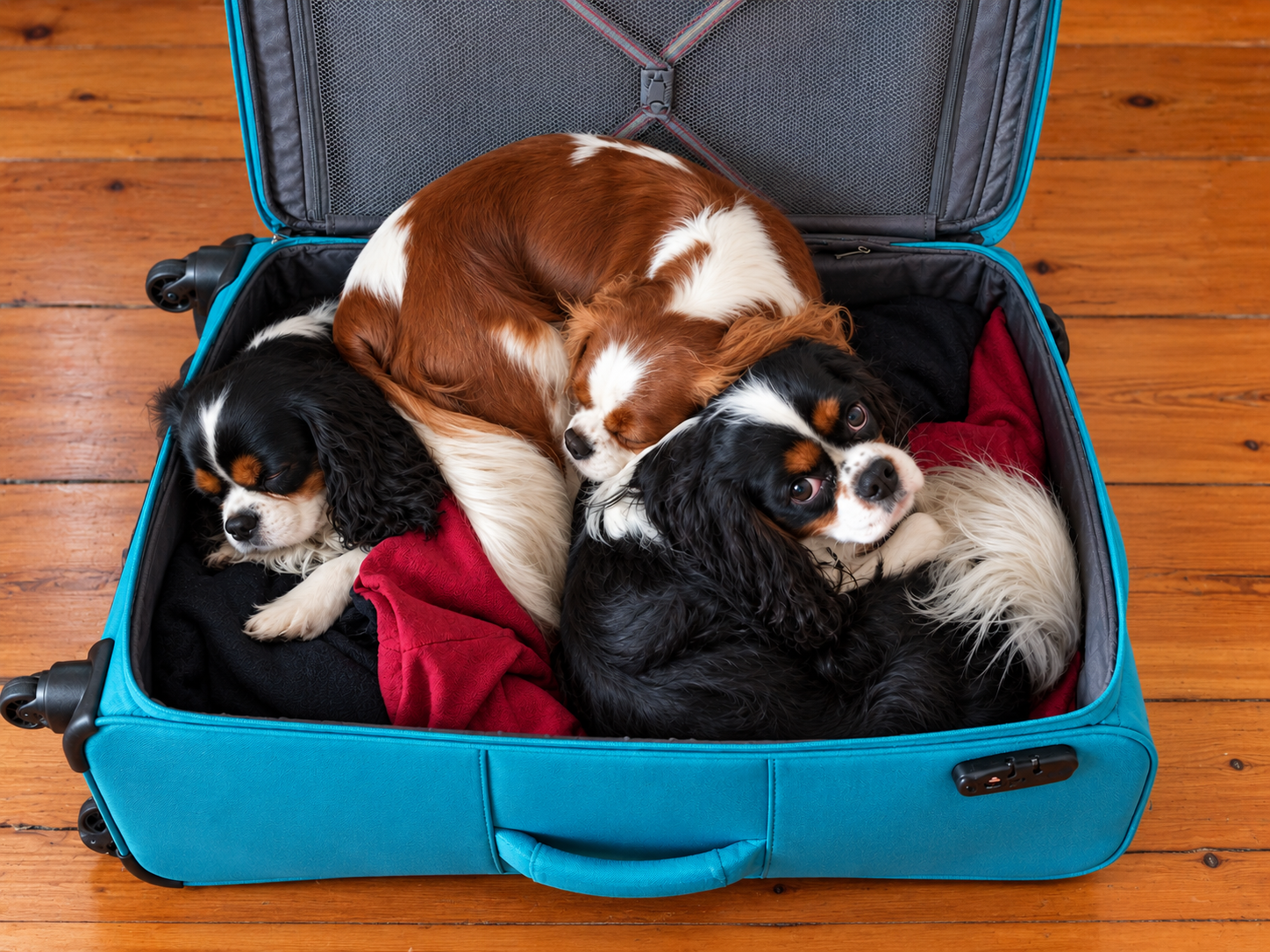
Photo credit: Cavalier King Charles Spaniel Club (Queensland)
Before you travel with your Cavalier
Good preparation should begin well before departure day.
Before travelling, consider your Cavalier's:
Health
Age
Temperament
Experience with car travel
Ability to cope with unfamiliar environments
Exercise requirements
Medication requirements
Vaccination status
Parasite prevention
Individual medical conditions
If your Cavalier has an existing health condition, is elderly, becomes particularly anxious when travelling or has previously experienced motion sickness, discuss your travel plans with your veterinarian before departure.
Your veterinarian can also advise whether your dog's preventative healthcare is appropriate for the destination. Parasite risks can vary between regions, and some areas of Australia have particular risks such as paralysis ticks or brown dog ticks.
Make sure your Cavalier can be identified
Before leaving home, check that your Cavalier's microchip registration details are current. Your dog should also wear a secure collar or harness with an identification tag containing current contact details. This is particularly important when travelling because an unfamiliar environment can increase the risk of a dog becoming frightened and escaping.
Make sure your dog's registration requirements are also up to date and check that your microchip details can be accessed nationally if you are travelling interstate.
Veterinary check-up before travelling
A routine veterinary check-up may be worthwhile before a significant trip, particularly if your Cavalier is older or has an existing health condition.
Discuss:
Whether your Cavalier is fit to travel
Vaccination status
Flea and tick prevention
Heartworm prevention
Worming
Any current medications
Motion sickness
Anxiety or travel-related stress
The health risks associated with your destination
Any additional preventative treatments that may be appropriate
If your Cavalier takes prescription medication, take enough medication for the entire trip, with additional supplies in case your return is delayed. Keep medication in its original packaging and carry relevant veterinary documentation where appropriate.
Getting your Cavalier comfortable with the car
Not every dog naturally enjoys travelling in a car. If your Cavalier is nervous, gradually introduce them to car travel before your holiday. Start with short, positive experiences. Your Cavalier might initially sit in the stationary car with the engine off, followed by very short journeys. Gradually increase the duration as your dog becomes comfortable.
Use reward-based training and allow your Cavalier to progress at their own pace rather than forcing them to remain in the car when they are frightened.
If your Cavalier becomes nauseous or experiences motion sickness, speak with your veterinarian before travelling. Do not give human medications or sedatives unless specifically advised by your veterinarian.
Secure your Cavalier in the vehicle
Your Cavalier should be appropriately restrained whenever travelling in a vehicle.
Depending on the vehicle and your dog's individual needs, this may involve an appropriate crash-tested harness, secured travel crate or another suitable restraint system.
A travel crate should be large enough for your Cavalier to stand, sit, turn around and lie down comfortably, while being securely positioned so that it cannot move around the vehicle.
The correct restraint also helps prevent your dog from moving around the vehicle and distracting the driver.
Never allow your Cavalier to travel loose in the vehicle, sit on the driver's lap or ride unsecured in the back of a ute.
Road rules relating to dogs travelling in vehicles can differ between Australian states and territories, so check the requirements that apply to your journey.
Never leave your Cavalier alone in a car
This is one of the most important rules of travelling with your dog.
Never leave your Cavalier unattended inside a parked vehicle, even if:
The windows are open
The car is parked in the shade
The weather does not feel particularly hot
You are only going inside “for a few minutes”
The air conditioning was operating before you left
Vehicles can become dangerously hot very quickly, and dogs can develop potentially fatal heat stress. Queensland's climate makes this particularly important.
If you cannot take your Cavalier with you when you leave the vehicle, reconsider whether your dog should be accompanying you at that stop.
Plan regular breaks
Long journeys should include regular opportunities for your Cavalier to:
Toilet
Stretch their legs
Drink water
Relax
Have a short, safe walk
Choose secure areas for breaks and keep your Cavalier on a lead, particularly in unfamiliar locations. Even a normally reliable dog can become frightened by unfamiliar surroundings and attempt to run away. Allow enough time for breaks rather than trying to reach your destination as quickly as possible.
A relaxed journey is usually better for everyone.
Keep your Cavalier hydrated
Take plenty of fresh water with you. Do not rely on being able to find a suitable water source along the way.
It is sensible to carry more water than you expect to need in case of delays, unexpected traffic, detours or hot weather. Offer water regularly, particularly during warm weather and after exercise.
Be particularly careful in Queensland's heat
Heat is an important consideration when travelling with a Cavalier. Avoid travelling or exercising your dog during the hottest part of the day whenever possible.
On hot days, plan walks and toilet breaks for cooler periods and ensure your Cavalier has access to shade, ventilation and fresh water. Watch for signs of heat stress, including excessive or persistent panting, drooling, agitation, weakness, vomiting, diarrhoea, breathing difficulties or collapse. Heatstroke is an emergency. If you suspect your Cavalier is suffering from heatstroke, begin appropriate cooling measures and seek veterinary attention immediately.
What to pack for your Cavalier
Create a dedicated travel bag for your dog.
Consider packing:
Your Cavalier's usual food
Treats
Fresh drinking water
Food and water bowls
Lead and harness
Collar and identification tag
Secure travel restraint or crate
Bedding
Familiar blanket
Favourite toy
Waste bags
Towel
Grooming supplies
Any required medications
Copies of relevant veterinary records
Vaccination information
First-aid supplies suitable for dogs
Cooling equipment where appropriate
Spare food and water
Spare lead or harness
Taking familiar items from home can also help your Cavalier settle in an unfamiliar environment.
Take your Cavalier's usual food
Travel is generally not the best time to introduce a completely new diet.
Taking your dog's usual food can help maintain dietary consistency and reduce the likelihood of digestive upset.
If you need to change your Cavalier's diet before travelling, make the change gradually rather than immediately before departure.
Take enough food for the entire trip, plus some extra in case of unexpected delays.
Bring familiar items from home
A familiar bed, blanket or toy can provide reassurance in an unfamiliar environment.
Dogs rely heavily on familiar smells, and bringing some of your Cavalier's usual belongings can help make a new environment feel more familiar.
Try to maintain familiar routines around:
Mealtimes
Bedtime
Exercise
Toilet breaks
Rest
Medication
The more predictable the routine, the easier the transition may be.
Staying in pet-friendly accommodation
Before booking accommodation, check the property's pet policy carefully.
Do not assume that “pet-friendly” means that dogs are permitted everywhere on the property.
Ask about:
Where your Cavalier is allowed
Whether dogs can be left unattended
Outdoor areas
Fencing
Access to walking areas
Additional cleaning fees
Rules regarding furniture
Other animals on the property
Local off-leash areas
Nearby veterinary services
Never leave your Cavalier alone in an unfamiliar accommodation environment if there is a risk they may escape, become distressed or cause themselves harm.
Check the environment before letting your Cavalier explore
When you arrive somewhere new, inspect the area before allowing your Cavalier off lead.
Look for:
Gaps in fencing
Open gates
Pools or other water hazards
Roads nearby
Toxic plants
Sharp objects
Other animals
Potential escape routes
Until you know that an area is secure, keep your Cavalier on a lead.
An unfamiliar environment can be exciting and overwhelming, and even a well-trained dog may behave differently when exposed to unfamiliar sights, smells and sounds.
Travelling interstate with your Cavalier
Australia has different state and territory laws and biosecurity requirements.
Before travelling interstate, check the requirements that apply to every state or territory you will enter or pass through.
This is particularly important when travelling to areas where particular diseases or parasites occur.
For example, canine ehrlichiosis is a tick-borne disease present in parts of northern Australia, including north-western Queensland. Travellers should be aware of brown dog ticks and use appropriate tick prevention.
Do not assume that the parasite prevention you normally use at home provides the same protection for every destination.
Ask your veterinarian about the risks associated with your particular travel itinerary.
Travelling internationally with your Cavalier
International travel with a dog requires considerably more preparation than travelling within Australia.
Every country has its own requirements for importing dogs. These can include:
Microchipping
Vaccinations
Blood testing
Parasite treatments
Veterinary examinations
Health certificates
Import permits
Government approvals
Quarantine requirements
Australia also has specific requirements for dogs returning to the country.
If you are considering international travel, start researching the requirements well in advance. Some preparations need to occur months before departure.
Do not book your Cavalier's international travel until you have checked the requirements of both the destination country and Australia.
Flying with your Cavalier
Air travel requires additional consideration.
Not every dog is an appropriate candidate for air travel, and airlines have their own policies regarding the transportation of animals.
Before booking:
Check the airline's current animal transport requirements
Ask your veterinarian whether your Cavalier is fit to fly
Check the requirements for the destination
Confirm crate requirements
Check temperature restrictions
Understand the arrangements for your dog throughout the journey
Allow additional time for required veterinary examinations and documentation
For air or sea transport, the RSPCA recommends consulting a veterinarian at least one month before travel to assess the animal's suitability and allow time to address any health concerns.
Never give your Cavalier a sedative for air travel unless specifically directed by your veterinarian.
Finding veterinary care while travelling
Before leaving home, research veterinary clinics at your destination.
For a longer road trip, identify veterinary clinics or emergency hospitals along your route.
Save their contact details to your phone rather than relying on finding a clinic during an emergency.
Take your Cavalier's veterinary records with you, particularly if your dog has an existing medical condition.
What if your Cavalier isn't coming with you?
Sometimes the best decision is to leave your Cavalier at home or arrange alternative care.
This may be appropriate when:
Your destination is unsuitable for dogs
Your travel arrangements would be stressful for your dog
The journey is exceptionally long
Your accommodation isn't appropriate
Your Cavalier has a medical condition that makes travel undesirable
Your Cavalier is elderly or particularly vulnerable
You are travelling somewhere with significant health or environmental risks
Leaving your Cavalier behind does not mean you have to leave them without care and reassurance.
With careful preparation, many dogs can cope well while their owners are away.
Choosing someone to care for your Cavalier
Choose a person or facility that understands your dog's individual needs.
Depending on your Cavalier, options may include:
A trusted family member
A friend
A professional pet sitter
In-home care
A reputable dog hotel or boarding facility
Consider your Cavalier's personality when making the decision. A sociable dog may enjoy staying somewhere with other dogs, while a dog that prefers a quiet environment may be more comfortable receiving care in their own home.
The best option is not necessarily the same for every dog.
Prepare your Cavalier before you leave
If your Cavalier is going to stay somewhere unfamiliar, introduce them to the environment before your holiday whenever possible.
For example, you could arrange:
A short visit
A few hours of care
A daytime stay
An overnight stay
This gives you an opportunity to see how your Cavalier responds before committing to a longer stay.
If your dog will be cared for in your home, arrange for the carer to spend time with your Cavalier before you leave.
The aim is to make the person, environment and routine familiar before your departure.
Maintain your Cavalier's routine
Dogs generally benefit from predictability.
Where possible, keep your Cavalier's normal:
Feeding times
Food
Medication schedule
Exercise routine
Sleeping arrangements
Toilet routine
Enrichment activities
Avoid making unnecessary changes immediately before you leave.
If your Cavalier normally sleeps in a particular bed or has a favourite blanket, send these familiar items with them if they are staying elsewhere.
Don't make departures unnecessarily dramatic
It can be tempting to give your Cavalier an emotional goodbye before leaving.
However, keeping departures calm and predictable can help reduce the significance of the event.
If your Cavalier becomes anxious when you prepare to leave, practise calm departures before the trip.
For example, occasionally pick up your keys, put on your shoes and leave the house for a short period without creating a prolonged goodbye ritual.
The goal is to make departures a normal part of life rather than an unusual event.
Separation anxiety
Some dogs experience genuine separation anxiety when separated from a person or animal to whom they are strongly attached.
Signs can include:
Excessive barking or vocalisation
Pacing
Destructive behaviour
Toileting indoors
Digging
Attempts to escape
Restlessness
Excessive distress when the owner leaves
These behaviours should not simply be interpreted as a dog being “naughty”.
Separation-related anxiety is a behavioural problem that may require a structured management and behaviour-modification plan. Your veterinarian can help determine whether anxiety is involved and may refer you to an appropriately qualified behaviour professional.
Helping an anxious Cavalier before you travel
If your Cavalier becomes distressed when you leave, start preparing well before your holiday.
Your veterinarian or qualified behaviour professional may recommend strategies such as:
Gradually increasing periods of separation
Reward-based training
Creating positive associations with being alone
Establishing calm departure and arrival routines
Providing appropriate enrichment
Modifying the home environment
Using a carefully planned care arrangement
Do not wait until the day before your holiday to address significant separation anxiety.
Behavioural change takes time, and severe cases may require professional assistance.
Leave clear instructions for your Cavalier's carer
Prepare a written care sheet containing:
Your Cavalier's name and age
Feeding schedule
Food and portion sizes
Treats
Medication
Veterinary details
Emergency veterinary contact
Microchip information
Exercise routine
Sleeping routine
Behavioural characteristics
Known fears
Triggers
Favourite activities
Things your dog dislikes
Normal toileting habits
Your contact details
An emergency contact who can make decisions if you cannot be reached
Include photographs if your Cavalier has a distinctive appearance or if there are multiple dogs in the household.
The more information your carer has, the more closely they can replicate your dog's normal routine.
Leave something that smells like home
A familiar blanket or item of clothing carrying your scent may provide comfort to some dogs.
Choose something safe that your Cavalier is already accustomed to and that cannot easily be chewed or swallowed.
The aim is familiarity, not introducing a new object while you are away.
Keep your Cavalier mentally occupied
Appropriate enrichment can help provide structure and stimulation while you are away.
Depending on your Cavalier's individual needs, this could include:
Snuffle activities
Food puzzles
Safe chew items
Treat searches
Gentle training
Interactive play
Short walks
Scent-based activities
Enrichment should be appropriate for the individual dog and supervised where necessary.
Keep communication with the carer sensible
It can be reassuring for you to receive updates while you are away.
Ask your carer to let you know about significant changes in:
Appetite
Toileting
Behaviour
Exercise
Medication
General wellbeing
Photographs or short videos can also reassure you that your Cavalier is settling in.
However, avoid constantly changing the routine because you are worried about your dog. Your Cavalier's carer should be able to maintain a calm and consistent environment.
Travel with or without your Cavalier?
There is no universal answer. For some Cavaliers, travelling with their family is enjoyable and enriching. For others, a familiar home environment with a trusted carer may be the more comfortable option.
Consider your dog's:
Health
Age
Temperament
Travel experience
Anxiety levels
Destination
Length of journey
Climate
Accommodation
Individual care requirements
The best choice is the option that provides the greatest combination of safety, comfort, appropriate care and minimal unnecessary stress.
Travel checklist for your Cavalier
Before leaving, work through this checklist:
Health
☐ Veterinary check-up if appropriate
☐ Vaccinations current
☐ Flea prevention current
☐ Tick prevention appropriate for destination
☐ Worming up to date
☐ Heartworm prevention current
☐ Medication packed
☐ Veterinary records packed
Identification
☐ Microchip details checked
☐ Registration current
☐ Identification tag attached
☐ Contact details current
Travel
☐ Appropriate restraint or secure crate
☐ Lead and harness
☐ Fresh water
☐ Food
☐ Bowls
☐ Bedding
☐ Familiar blanket or toy
☐ Waste bags
☐ Towels
☐ Grooming supplies
☐ First-aid supplies
Destination
☐ Accommodation confirmed as dog-friendly
☐ Secure outdoor area checked
☐ Local veterinary clinic identified
☐ Emergency veterinary clinic identified
☐ Local dog restrictions checked
☐ State or territory requirements checked
☐ Weather forecast considered
If your Cavalier is staying behind
☐ Carer selected
☐ Trial stay or visit completed where appropriate
☐ Written care instructions prepared
☐ Food supplied
☐ Medication supplied
☐ Veterinary details supplied
☐ Emergency contact supplied
☐ Familiar bedding supplied
☐ Routine explained to carer
A safe journey is a happy journey
Travelling with your Cavalier can be a wonderful way to share new experiences together, but your dog's safety and wellbeing should always come first.
Take the time to prepare your Cavalier for the journey, secure them appropriately, provide regular breaks, keep them hydrated and never leave them unattended in a vehicle.
If your Cavalier is staying behind, choose their care arrangement based on their individual personality and needs. Maintaining familiar routines, providing trusted care and preparing for separation well in advance can help make your time apart easier for both of you.
Whether your Cavalier is travelling by your side or enjoying a staycation with a trusted carer, thoughtful preparation can help ensure they remain safe, comfortable and well cared for while you are away.