

Ticks in Cavalier King Charles Spaniels
Ticks are small blood-feeding parasites, but for Cavalier King Charles Spaniels living in or travelling through tick-prone areas of Australia, they can pose a serious health risk. The Australian paralysis tick, Ixodes holocyclus, is particularly important for dog owners along the eastern coast of Australia. Its toxin can cause rapidly progressing paralysis and, in severe cases, respiratory failure and death.
The good news is that effective tick prevention, daily tick checks and prompt veterinary attention can significantly improve your Cavalier's protection.
If your Cavalier shows signs that could indicate tick paralysis, seek veterinary attention immediately. Tick paralysis can progress quickly and is a veterinary emergency.
What are ticks?
Ticks are parasites that feed on the blood of animals.
They are commonly found in areas with vegetation, including bushland, long grass, leaf litter and other environments where they can attach to passing animals. Ticks are particularly relevant to dogs that spend time outdoors or live in areas where paralysis ticks occur.
A tick can attach to your Cavalier and remain there while feeding. Because ticks can be small and difficult to see, particularly in a Cavalier's long, silky coat, regular checking is important.
Why are ticks dangerous to Cavaliers?
Not all ticks pose the same level of risk. Australia has several species of ticks that can affect dogs, but the paralysis tick is particularly dangerous. The paralysis tick produces a toxin in its saliva that can affect the nervous system and cause progressive weakness and paralysis. In severe cases, the muscles involved in breathing can become affected.
This is why finding a tick on your Cavalier should always be taken seriously.
What is tick paralysis?
Tick paralysis, also known as tick toxicosis, occurs when toxin produced by certain ticks affects the nervous system. In Australia, Ixodes holocyclus is responsible for a particularly severe form of tick paralysis, especially along the eastern coast.
Signs can develop after the tick has attached and may continue to progress even after the tick has been removed. Tick paralysis can become life-threatening, so early veterinary treatment is essential.
Signs of tick paralysis in a Cavalier
Early signs can sometimes be subtle.
Watch for:
Hind-leg weakness
An unsteady or wobbly walk
Difficulty standing
A change in your Cavalier's bark or voice
Gagging or coughing
Retching
Vomiting or regurgitation
Excessive drooling
Difficulty swallowing
Changes in breathing
Weakness that appears to progress
Difficulty sitting or standing
Collapse
These signs can progress to paralysis and respiratory problems.
If your Cavalier develops sudden weakness, breathing difficulties or other signs consistent with tick paralysis, seek emergency veterinary attention immediately.
Where should I look for ticks?
Ticks can attach anywhere on your Cavalier, but particular attention should be paid to the head and neck.
Check carefully around:
The face
Around the eyes
Around and inside the ears
Under the ears
Around the lips
Under the collar
The neck
The shoulders
Between the toes
Around the paws
The legs
The groin
Around the anus
Ticks can also hide in areas that are difficult to see or feel, including inside the ears and between the toes. A complete body search is therefore important.
How to check your Cavalier for ticks
Daily checking is one of the most important things you can do to protect your Cavalier.
Run your fingers slowly through the coat, feeling the skin underneath rather than simply looking at the hair.
Start at the head and work methodically towards the tail.
Pay particular attention to the face, ears, neck, paws and between the toes.
A Cavalier's long coat can make ticks difficult to see, so a hands-on check is particularly important.
Even if your Cavalier receives tick prevention, daily checks remain an important part of protection.
What should I do if I find a tick?
If you find a tick on your Cavalier, remove it promptly and contact your veterinarian for advice. A tick-removal device, tweezers or fingers may be used to remove a tick with a twist-and-pluck action. Veterinary guidance recommends removing ticks immediately and, where possible, retaining the tick for identification.
However, if your Cavalier is showing any signs of tick paralysis, do not delay veterinary treatment while attempting to manage the problem at home.
Take your Cavalier to a veterinarian urgently.
What if I remove the tick but my Cavalier seems fine?
Continue to monitor your Cavalier closely. In Australian paralysis tick cases, signs can continue to develop or worsen after the tick has been removed because toxin may already have entered the dog's system.
If your Cavalier develops weakness, breathing changes, gagging, coughing, vomiting, difficulty swallowing or any other concerning symptoms after a tick has been found or removed, seek veterinary attention immediately.
How can I prevent ticks?
Prevention is one of the most important parts of protecting your Cavalier. Speak with your veterinarian about an appropriate tick-prevention product for your dog.
There are different types of parasite-prevention products, including oral and topical treatments and other veterinary products. The appropriate choice depends on your Cavalier's age, weight, health, lifestyle and individual circumstances.
The Australian Paralysis Tick Advisory Panel recommends year-round use of appropriate tick prevention for dogs living in or travelling to known paralysis-tick regions.
Your veterinarian can recommend the most suitable product and schedule for your Cavalier.
Does tick prevention mean I don't need to check my Cavalier?
No. Tick prevention is extremely important, but daily tick searching should still be part of your routine, particularly if your Cavalier lives in or travels to an area where paralysis ticks are present.
No prevention strategy should replace checking your dog regularly for attached ticks. This is particularly important for Cavaliers because their long, feathered coats can make ticks difficult to find.
Where are paralysis ticks found?
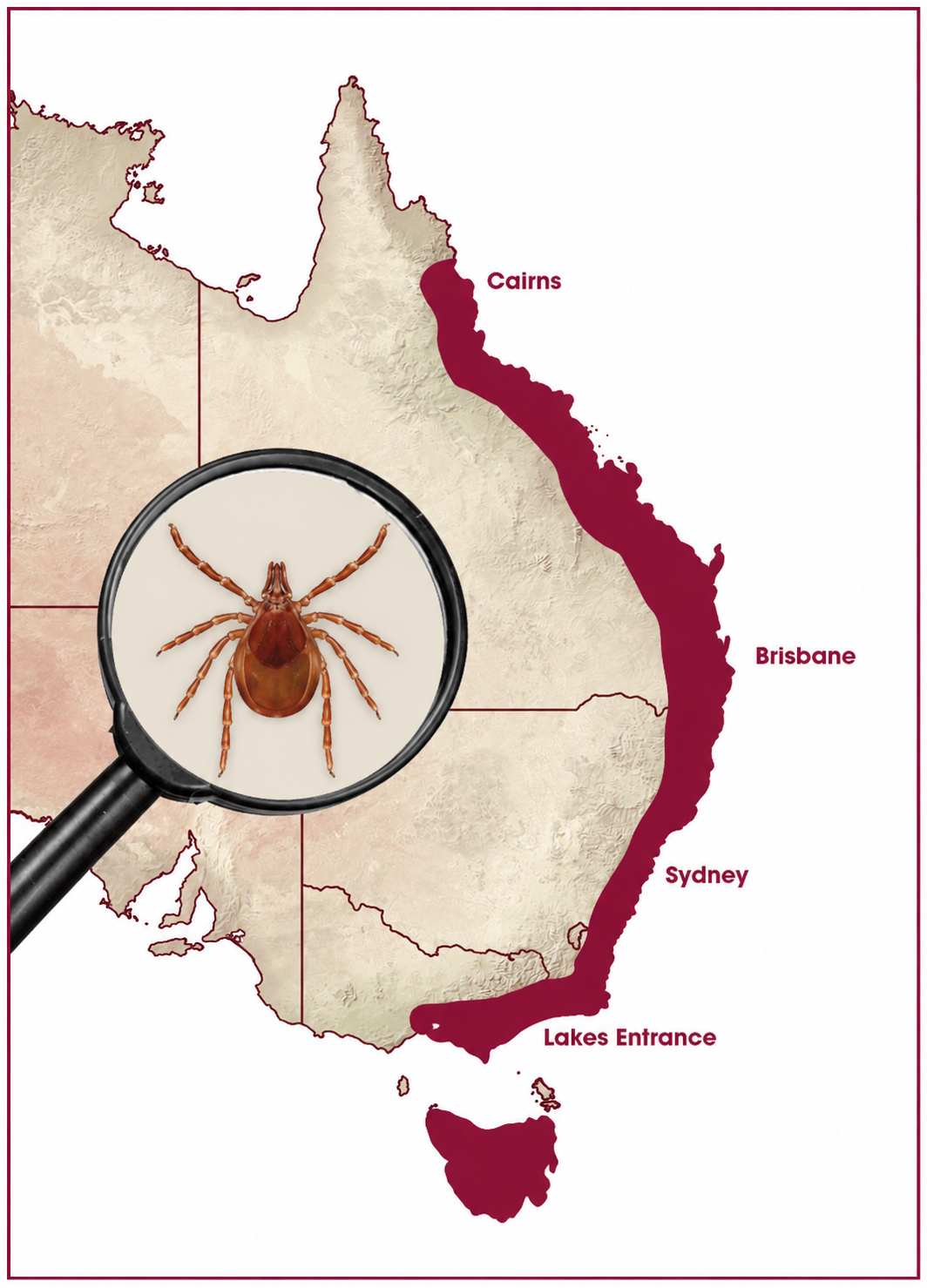
Pictured: Map of Paralysis Tick distribution along the Australian Eastern seaboard. Note: Australian Eastern Paralysis Tick is on the Mainland only. Tasmania has a different paralysis tick.
Image credit: Cavalier King Charles Spaniel Club (Queensland)
Paralysis ticks are found along Australia's eastern coastline and are particularly important in areas where environmental conditions support their life cycle. For Cavalier owners in Queensland and other eastern Australian regions, tick prevention should therefore be taken seriously.
Your local veterinarian can provide advice about the level of tick risk in your area and the most appropriate prevention program.
Can ticks be found all year?
Yes. Although tick activity can vary throughout the year and may increase during particular environmental conditions, paralysis ticks should not be regarded as a risk only during a short "tick season".
Australian veterinary guidance recommends year-round prevention for dogs living in or travelling to known paralysis-tick areas.
Can I prevent my Cavalier from entering tick areas?
Reducing exposure can help lower the risk.
Where practical:
Avoid dense vegetation and long grass
Keep your Cavalier on cleared paths when walking in tick-prone areas
Check your Cavalier after outdoor activities
Keep grass and vegetation around your property appropriately managed
Perform a thorough tick search every day
Maintain your veterinarian-recommended tick prevention
However, it is important to understand that ticks can occur in many environments, so avoiding obvious bushland does not guarantee that your Cavalier will not encounter a tick.
Why are Cavalier King Charles Spaniels particularly challenging to check?
Cavaliers have beautiful, long, silky coats with feathering around their ears, legs, chest and body. While this coat is one of the breed's most recognisable characteristics, it can also make parasites more difficult to find.
A tick may be hidden beneath the hair, making a visual inspection alone insufficient. Running your fingers carefully over the skin is therefore an important part of your Cavalier's daily tick check.
When is tick paralysis an emergency?
Tick paralysis should always be treated as a veterinary emergency when clinical signs are present.
Seek immediate veterinary attention if your Cavalier:
Suddenly becomes weak
Develops hind-leg weakness
Has difficulty walking
Develops a change in their bark
Starts gagging or coughing
Has difficulty swallowing
Vomits or regurgitates
Has excessive drooling
Develops breathing difficulties
Collapses
Tick paralysis can progress rapidly and can ultimately affect the muscles required for breathing.
Do not wait to see whether the symptoms improve.
Ticks and puppies
Puppies require particularly careful parasite protection. Their smaller size means that significant parasite burdens can be more concerning, and young puppies may also be less able to tolerate illness.
Your veterinarian can establish an appropriate parasite-prevention program based on your puppy's age, weight and lifestyle.
Never use a tick product on a puppy unless it is appropriate for their age and weight and is being used according to veterinary or product instructions.
Ticks and older Cavaliers
Senior Cavaliers also deserve careful protection. Older dogs may have existing health conditions or take medications that need to be considered when choosing parasite-prevention products.
If your senior Cavalier's health or medication has changed, speak with your veterinarian about whether their parasite-prevention program remains appropriate.
Prevention, checking and quick action
Protecting your Cavalier from ticks involves three important steps:
Use an appropriate veterinary-recommended tick-prevention program.
Check your Cavalier thoroughly for ticks every day.
Act immediately if you find a tick or notice signs of illness.
These simple habits can help reduce the risk of tick-related illness and may give your Cavalier a better chance of receiving prompt treatment if a problem occurs.
Keeping your Cavalier safe from ticks
Ticks may be tiny, but paralysis ticks can pose a serious and potentially life-threatening risk to Cavalier King Charles Spaniels.
Don't rely on being able to see a tick. Make daily tick checks part of your Cavalier's routine, particularly after spending time outdoors.
If you live in or travel to a paralysis-tick area, speak with your veterinarian about year-round prevention and make sure every member of your household knows the signs of tick paralysis.
Most importantly, if your Cavalier develops sudden weakness, breathing difficulties, gagging, coughing, vomiting or other symptoms that could indicate tick paralysis, seek veterinary attention immediately.
Disclaimer
The information provided in the Cavalier Knowledge Centre is intended for general educational purposes only and is not a substitute for veterinary advice, diagnosis or treatment. Tick prevention products should be selected according to the individual dog and used exactly as directed. If you find a tick on your Cavalier, or your Cavalier develops weakness, breathing difficulties or other signs that could indicate tick paralysis, seek veterinary attention immediately.