

Enrichment Games
Enrichment Games for Cavalier King Charles Spaniels

Pictured: Milo
Photo credit: The Dog Cottage GC
Cavalier King Charles Spaniels may be small in stature, but they are intelligent, curious and wonderfully interactive dogs. Their lives should involve more than meals, walks and a comfortable place to sleep. Enrichment games give your Cavalier opportunities to think, sniff, explore, problem-solve, learn and play.
The good news is that enrichment does not need to be complicated or expensive. Many of the best games can be created at home using your dog's normal food, toys and everyday household items.
Enrichment is an important part of good canine welfare because it allows dogs to engage in natural behaviours and provides positive mental and physical experiences. The RSPCA identifies activities such as puzzle toys, scent games, training, exploration and play as valuable forms of enrichment.
The best enrichment game isn't necessarily the most complicated one. It is the one your Cavalier enjoys, can safely complete and wants to play again.
What Are Enrichment Games?
Enrichment games are activities designed to stimulate a dog's mind, senses, body or natural behaviours.
They can involve:
Sniffing
Searching
Exploring
Problem-solving
Learning
Playing
Chewing appropriate items
Food investigation
Social interaction
Physical movement
Making choices
Some games provide several types of enrichment at once. For example, a simple treat hunt can involve scent, problem-solving, movement and food enrichment. The RSPCA describes enrichment as activities that engage a dog's mind, body and senses and allow dogs to express natural behaviours such as smelling, playing, exploring and interacting socially.
The Cavalier King Charles Spaniel breed standard describes the Cavalier as active, graceful and well balanced, with a sporting and affectionate character and a friendly, non-aggressive temperament. While individual Cavaliers vary considerably, their lives can benefit from opportunities to investigate their environment, learn and interact with their people.
Enrichment games can:
Provide mental stimulation
Encourage natural behaviours
Help alleviate boredom
Provide opportunities for problem-solving
Support positive learning
Strengthen the dog-human relationship
Add variety to everyday life
Provide appropriate physical activity
Give dogs opportunities to make choices
The RSPCA notes that enrichment can contribute to relaxation, resilience, reduced stress and anxiety, stronger relationships with people and a reduction in some undesirable behaviours.
Why Are Enrichment Games Important for Cavaliers?
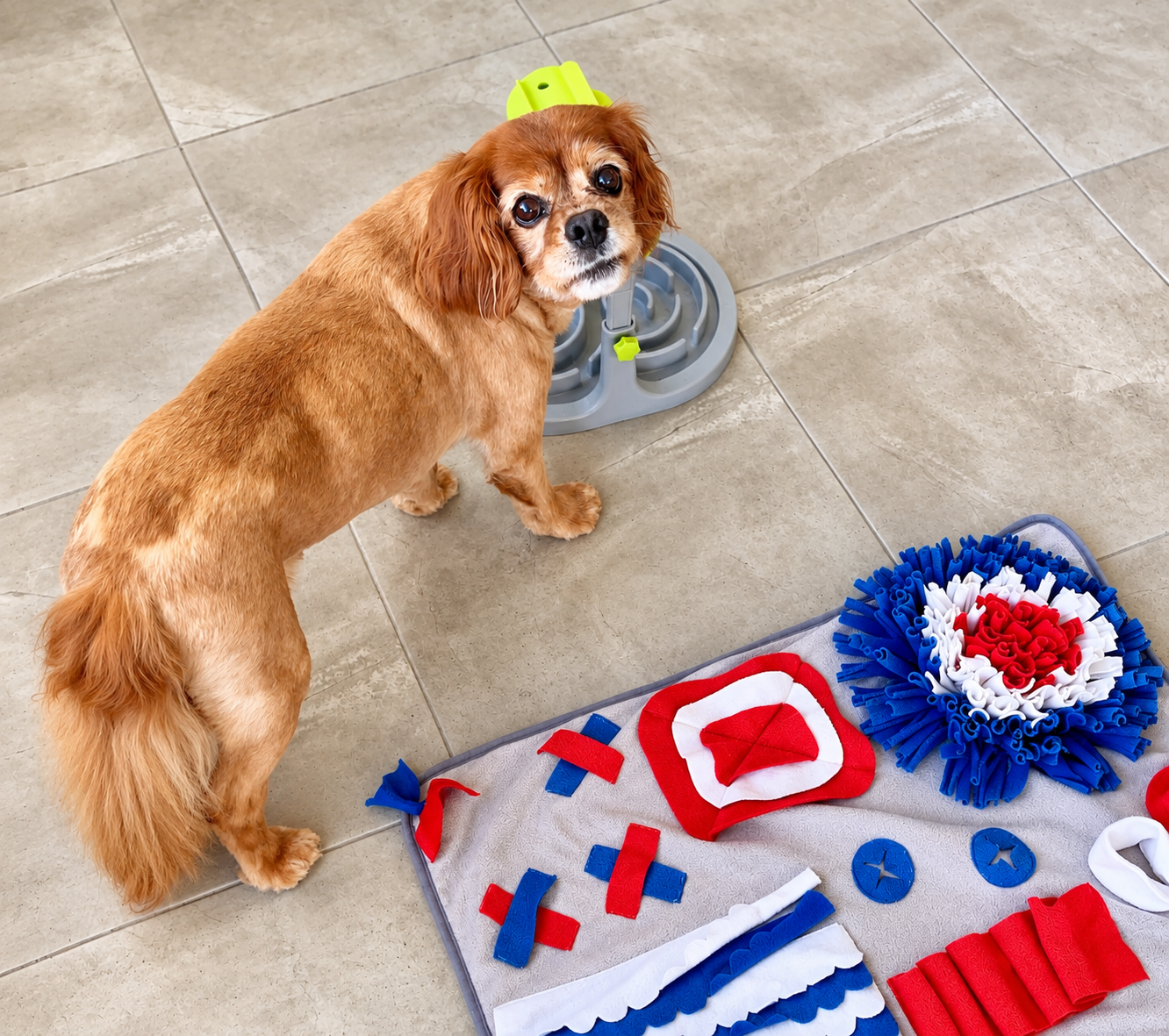
Pictured: Carly playing enrichment games
Photo credit: The Dog Cottage GC
Mental Enrichment vs Physical Exercise
These two things are related, but they are not the same. A walk provides physical exercise, but it can also provide enormous mental stimulation when your Cavalier is allowed to sniff and investigate. Likewise, a food puzzle may require very little physical exertion but provide a meaningful cognitive challenge.
A well-rounded lifestyle can include:
Physical exercise + mental enrichment + social interaction + training + rest
Your Cavalier needs all of these in appropriate amounts.
15 Enrichment Games to Play With Your Cavalier
Here are some simple games you can introduce at home.
1. The "Find It" Game
This is one of the easiest enrichment games to teach.
How to play
Show your Cavalier a small piece of their normal food or a suitable treat.
Allow them to sniff it.
Place it a short distance away.
Say "find it".
Let them investigate.
Celebrate when they discover it.
Start with the food in plain sight. Once your Cavalier understands the game, make the hiding places progressively more challenging.
Why it's great
Your dog gets to use their nose and practise searching and problem-solving.
2. The Cavalier Treasure Hunt
Take the "Find It" game one step further.
Hide several small pieces of your Cavalier's normal daily food around a safe area.
Try:
Behind a chair
Beside a table leg
Under an appropriate toy
Behind a cushion
In a cardboard box
Around a secure garden area
Begin with easy hiding places. As your Cavalier becomes more experienced, increase the difficulty.
Important
Make sure your dog cannot access:
Toxic substances
Electrical cords
Small objects
Dangerous plants
Cleaning products
Food that is unsafe for dogs
3. The Muffin Tray Game
A muffin tray can become a simple food puzzle.
Place small portions of your Cavalier's normal food into several compartments.
For an easy version, leave the compartments uncovered.
Once your dog understands the game, you can place suitable objects over some compartments, provided they are safe and cannot be swallowed.
Always supervise.
If your Cavalier attempts to chew or destroy the tray or objects, choose another enrichment activity.
4. The Cardboard Box Game
A simple cardboard box can provide an excellent investigation game.
Place some safe paper or cardboard material inside a box and hide a few pieces of your Cavalier's normal food among it.
Allow your dog to investigate and search.
This provides opportunities to:
Sniff
Search
Explore
Manipulate objects
Problem-solve
Safety first
Only use clean, untreated cardboard and paper.
Supervise your dog and remove the activity if they begin swallowing pieces.
5. The Snuffle Mat Game
A snuffle mat encourages your Cavalier to use their nose to locate food hidden within the material.
Scatter a portion of their normal food through the mat and let them search.
This is particularly useful for dogs who enjoy scent-based activities.
The RSPCA identifies snuffle mats and other scent-based activities as forms of enrichment that can increase engagement and may support relaxation.
6. Which Hand?
This is a wonderfully simple game requiring no equipment.
Place a small piece of food in one hand.
Close both hands.
Present them to your Cavalier and allow them to investigate.
When they indicate the correct hand, open it and provide the reward.
Once your Cavalier understands the game, you can gradually increase the challenge.
This game encourages your dog to use their nose and make a choice.
7. Cup Search
Place several cups upside down.
Hide a small piece of food under one cup.
Let your Cavalier investigate and discover which cup contains the reward.
Start with only two cups.
Once your dog understands the game, gradually increase the number.
Keep it fun rather than frustrating.
If your Cavalier starts knocking every cup over without investigating, that's perfectly fine — they are still playing the game!
8. The Shell Game
This is a more advanced version of the cup game.
Place a treat beneath one of several cups.
Move the cups slowly.
Encourage your Cavalier to identify where the treat has gone.
This can become a fun little problem-solving challenge.
Remember that dogs don't necessarily understand the game in exactly the same way humans do. The objective is not to prove your Cavalier is a genius. The objective is to give them a rewarding experience.
9. Toy Hide-and-Seek
Food isn't the only reward you can use.
Hide one of your Cavalier's favourite toys somewhere accessible.
Encourage your dog to find it.
When they discover it, play together.
This can be especially useful for dogs who are highly motivated by toys rather than food.
10. Teach a New Trick
Training is enrichment. And Cavaliers can learn an enormous variety of behaviours.
Try teaching:
Shake
Wave
Spin
Touch
Bow
High five
Go to bed
Put a toy in a basket
Find a toy
Walk around an object
Target your hand
Training provides mental stimulation while strengthening communication between dog and human. The RSPCA recommends reward-based training and identifies training as an important source of mental stimulation and a way of strengthening the human-dog relationship.
11. The "Touch" Game
Teach your Cavalier to touch your hand with their nose.
Step 1: Present your open hand close to their nose.
Step 2: When they investigate or touch it, reward them.
Step 3: Repeat.
Step 4: Introduce a verbal cue such as "touch".
Step 5: Gradually move your hand further away.
This simple behaviour can eventually become the foundation for more complicated training games.
12. The "Go to Your Mat" Game
Teaching your Cavalier to go to a particular mat or bed can be both useful and mentally stimulating.
Reward your dog for:
Looking at the mat
Approaching it
Standing on it
Sitting on it
Lying down
Remaining there calmly
This teaches a valuable life skill while giving your dog a clear and rewarding behaviour. Use positive reinforcement rather than forcing your dog onto the mat. Reward-based training involves setting dogs up for success and reinforcing desired behaviour.
13. The Sniffing Walk
You don't always need to walk further. Sometimes you can simply slow down. Allow your Cavalier to investigate appropriate smells during the walk.
Let them sniff:
Trees
Grass
Safe paths
Bushes
Interesting objects
Of course, keep your dog safe and under appropriate control. A sniffing walk can turn an ordinary outing into a rich sensory experience.
The RSPCA specifically encourages giving dogs opportunities to sniff and explore as part of enrichment.
14. The Obstacle Course
Create a simple indoor or outdoor obstacle course using safe household objects.
For example:
Walk around a chair
Step over a low pole
Walk between cushions
Go around a cone
Walk onto a stable platform
Keep everything low, stable and appropriate for your dog's physical ability. This is not about athletic performance. It is about thinking, following cues and navigating an environment. For a Cavalier with mobility limitations or health concerns, ask your veterinarian what activities are appropriate before introducing physical obstacles.
15. The Choice Game
Perhaps one of the most underrated enrichment activities is giving your dog appropriate choices.
Place two toys in front of your Cavalier.
Which one do they choose?
Offer a choice between:
Toy A or Toy B
Sniffing or playing
Food puzzle or training
Resting or interaction
Choice is an important component of positive welfare. The RSPCA emphasises the importance of giving dogs appropriate opportunities to express rewarding behaviours and experience choice and control.
Make Mealtimes an Enrichment Opportunity
You don't need to add extra food to create an enrichment game.
Instead, use part of your Cavalier's normal daily food allowance.
For example:
Breakfast: Use a food puzzle.
Lunch: Use a small amount of food for training.
Afternoon: Play a "Find It" game.
Dinner: Feed normally.
This allows you to introduce enrichment without unnecessarily increasing your dog's calorie intake. The RSPCA cautions that over-reliance on food-based enrichment can contribute to overfeeding and obesity.
Rotate Your Cavalier's Games
Don't provide every enrichment toy every day. Novelty matters. If your Cavalier receives exactly the same toy in exactly the same way every day, it may become less interesting. Instead, rotate activities.
For example:
Monday: Treasure hunt
Tuesday: Trick training
Wednesday: Snuffle mat
Thursday: Sniffing walk
Friday: Cardboard box search
Saturday: Toy hide-and-seek
Sunday: Choice game
The RSPCA recommends varying enrichment and notes that repetitive activities can become less beneficial over time.
Don't Make Every Game About Food
Food is an excellent motivator, but it shouldn't be the only form of enrichment.
Your Cavalier can also be rewarded with:
Praise
Affection
Play
A favourite toy
Access to an interesting environment
Sniffing opportunities
The RSPCA recognises food, toys, praise and play as possible rewards in reward-based training. This is particularly useful for Cavaliers who are very food motivated and need careful weight management.
Enrichment Games for Cavalier Puppies
Puppies are constantly learning about their world. Their enrichment should therefore include opportunities to experience new things safely and positively.
Try:
Simple "Find It" games
Very easy food puzzles
Gentle training
Exploring different safe surfaces
New toys
Appropriate sounds
Gentle handling
Short sniffing experiences
Toy-based games
Name-recognition games
Keep activities short. Puppies need plenty of sleep and rest, too.
Don't overwhelm your puppy
The objective is not to expose your puppy to as many experiences as possible in a single day.
Instead: New → Positive → Short → Successful
The RSPCA recommends that puppies have positive and varied experiences during their early socialisation period, while ensuring they have choice and are never forced into an experience that worries them.
Enrichment Games for Senior Cavaliers
Older Cavaliers can continue to enjoy enrichment. You may simply need to modify the activities.
Try:
Gentle scent games
Easy food puzzles
Short training sessions
Toy searches
"Find It"
Gentle interactive play
Calm exploration
Choice-based enrichment
If your senior Cavalier has arthritis, reduced mobility, vision changes, heart disease or another health condition, discuss appropriate activities with your veterinarian. Mental enrichment should work with your dog's body, not against it.
Enrichment for Cavaliers With Physical Limitations
Mental enrichment can be particularly useful when physical exercise needs to be restricted. For example, a dog recovering from an injury may not be able to enjoy its normal physical activities.
Appropriate alternatives may include:
Scent games
Simple food puzzles
Training
Toy identification
"Find It"
Calm interactive games
However, always follow your veterinarian's instructions during recovery.
What Makes a Good Enrichment Game?
A good enrichment activity should be:
Safe
It shouldn't create an unnecessary risk of injury, choking or ingestion.
Appropriate
It should suit your Cavalier's age, health, ability and temperament.
Achievable
Your dog should have a reasonable chance of succeeding.
Rewarding
Your Cavalier should actually enjoy doing it.
Varied
Different activities provide different forms of stimulation.
Voluntary
Your dog should not be forced to participate.
Watch Your Cavalier's Body Language
Your Cavalier will tell you whether an activity is working.
Signs of enjoyment may include:
Willing participation
Relaxed body language
Curiosity
Sniffing
Investigating
Appropriate persistence
Returning to the activity
Playfulness
Signs the activity may be too difficult or stressful:
Walking away
Whining
Barking in frustration
Excessive pawing
Avoidance
Fear
Agitation
Repeatedly giving up
If this happens, make the activity easier. Enrichment should create a positive experience, not a test your dog has to pass.
Avoid Turning Enrichment Into Frustration
There is a temptation to make games increasingly difficult. But harder does not automatically mean better. If your Cavalier solves a puzzle in 30 seconds, that's okay. If they take five minutes, that's okay too. If they don't enjoy the puzzle at all, choose something else.
The RSPCA emphasises that enrichment needs to be tailored to the individual dog and that dogs have different preferences.
Enrichment Games and Reward-Based Training
The Club recommends choosing reward-based training approaches. Reward-based training sets the dog up for success and reinforces desired behaviour with something the dog values.
It does not rely on:
Fear
Intimidation
Physical punishment
Pain
Force
Dominance-based methods
The RSPCA supports reward-based training and advises against aversive training methods because of their potential welfare and behavioural consequences.
This philosophy fits perfectly with enrichment: Make learning enjoyable. Help your dog succeed. Reward the behaviour you want.
Enrichment Games Are Not a Cure for Behaviour Problems
Enrichment can help address boredom and provide appropriate outlets for natural behaviours. But it should not be assumed that every unwanted behaviour is caused by boredom.
For example, excessive:
Barking
Destruction
Licking
Chewing
Whining
Pacing
Avoidance
may have many possible causes, including anxiety, fear, frustration, pain, illness or learned behaviour.
If your Cavalier develops a sudden or persistent behavioural change, speak with your veterinarian or an appropriately qualified behaviour professional.
Enrichment Safety
Before introducing any game, ask:
Could my dog swallow part of this?
Could this damage their teeth?
Could my dog become trapped?
Could another dog interfere?
Could the activity cause frustration?
Does my dog need supervision?
The RSPCA notes that poorly designed enrichment can create risks, including ingestion of toy materials and overfeeding through food-based activities. Always inspect enrichment equipment regularly. If it becomes damaged, replace it.
Be Careful With DIY Enrichment
DIY games can be wonderful. But "homemade" doesn't automatically mean "safe".
Avoid using:
Small objects that can be swallowed
Sharp materials
Toxic substances
Easily shredded materials
Fragile containers
Objects that can become lodged in the mouth
Anything that could trap a paw or jaw
If you are unsure, don't use it. There is no enrichment game worth risking your Cavalier's safety.
Don't Forget Rest
This is one of the most important points. A well-enriched dog doesn't need to be entertained constantly. Dogs need sleep and quiet time.
After an engaging activity, your Cavalier may simply want to: Eat → Relax → Sleep
And that's perfectly normal. Enrichment should complement rest, not prevent it.
10-Minute Enrichment Ideas
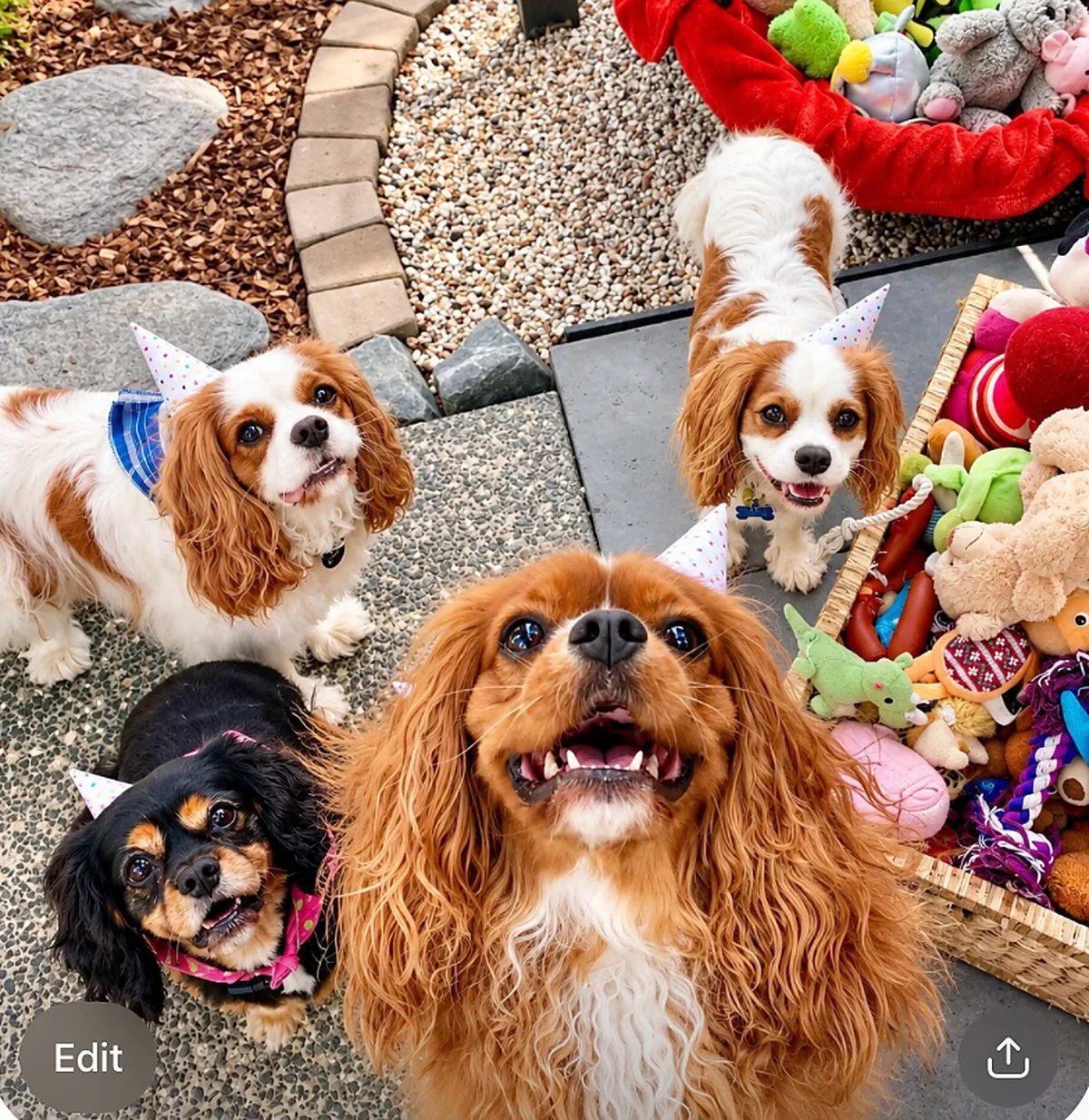
Pictured: Lady Lily-Grace, Charlie Frank, Milo & Teddy
Photo credit: The Dog Cottage GC
Don't have much time? Try one of these:
2 minutes: Teach "touch".
3 minutes: Play "Find It".
5 minutes: Practise three tricks.
5 minutes: Use a snuffle mat.
5 minutes: Hide a favourite toy.
10 minutes: Create a treasure hunt.
10 minutes: Take a slow sniffing walk.
Enrichment doesn't have to take hours. Small, positive experiences throughout the day can add variety to your Cavalier's life.
Enrichment Games for Multiple Cavaliers
If you have more than one dog, enrichment can become more complicated.
Some dogs may compete over:
Food
Toys
Puzzles
Hiding places
Human attention
Watch interactions carefully. For food-based enrichment, it may be safer to separate dogs so each can enjoy their activity without competition. Every dog should have the opportunity to participate without being intimidated or interrupted by another dog.
The Cavalier Enrichment Games Checklist
Use this checklist to create a varied enrichment routine.
☐ Play scent games
☐ Try "Find It"
☐ Create treasure hunts
☐ Use appropriate puzzle feeders
☐ Try a snuffle mat
☐ Teach new tricks
☐ Practise "Touch"
☐ Teach "Go to your mat"
☐ Hide favourite toys
☐ Use safe cardboard games
☐ Take sniffing walks
☐ Rotate enrichment activities
☐ Use part of the normal daily food allowance for food games
☐ Give your Cavalier appropriate choices
☐ Watch their body language
☐ Keep activities achievable
☐ Supervise potentially hazardous games
☐ Adapt activities for puppies and seniors
☐ Provide plenty of rest
☐ Use reward-based training
In Conclusion…
Enrichment games are a wonderful way to add fun, variety and purpose to your Cavalier King Charles Spaniel's everyday life. And you don't need expensive equipment.
A handful of their dinner.
A cardboard box.
A favourite toy.
A few minutes of training.
A slow sniffing walk.
A simple treasure hunt.
These ordinary things can become extraordinary experiences when your Cavalier gets to think, sniff, explore, learn and make choices.
References
Dogs Australia. (2008). Cavalier King Charles Spaniel breed standard. Dogs Australia – Cavalier King Charles Spaniel breed standard.
RSPCA Australia. (2023). Why is enrichment important for dogs? RSPCA Knowledgebase. RSPCA Knowledgebase – Why is enrichment important for dogs?.
RSPCA Australia. (2025). Is it important to train my dog? What sort of training would you recommend? RSPCA Knowledgebase. RSPCA Knowledgebase – Dog training.
RSPCA Australia. (2022). What is reward-based dog training and why does the RSPCA support it? RSPCA Knowledgebase. RSPCA Knowledgebase – Reward-based dog training.
RSPCA Australia. (2026). The importance of enrichment for dogs. RSPCA Australia – The importance of enrichment for dogs.
RSPCA Australia. (2022). How can I socialise my puppy? RSPCA Knowledgebase. RSPCA Knowledgebase – Puppy socialisation.
Disclaimer
This article is provided by the Cavalier King Charles Spaniel Club (Queensland) for general educational purposes. It is not a substitute for individual veterinary advice, diagnosis or treatment.